
Chicago Local SEO Ranking Factors That Still Matter in 2026
zolqix
Zolqix Team

Local SEO in Chicago has never been more competitive — or more complex. Google’s local ranking algorithm now weighs dozens of signals simultaneously, and the factors that moved rankings in 2021 don’t all carry the same weight in 2026.
Based on our experience managing local SEO campaigns for Chicago businesses across categories including home services, legal, healthcare, retail, and professional services, this guide covers the 17 ranking factors that still matter most — organized by category, ranked by real-world impact, and explained with Chicago-specific context that generic SEO guides miss.
We’ve grouped them into five categories that reflect how Google actually thinks about local ranking: Google Business Profile signals, review signals, citation and NAP signals, website and on-page signals, and behavioral and authority signals.

Quick Reference: All 17 Ranking Factors at a Glance
| # | Factor | Category | Impact (Chicago) | Quick Action |
| 1 | GBP Primary Category | GBP | Critical | Audit and correct immediately |
| 2 | GBP Profile Completeness | GBP | Very High | Fill every field today |
| 3 | GBP Photo Recency & Volume | GBP | High | Upload 5+ photos monthly |
| 4 | GBP Posts Activity | GBP | Medium | Post 2–4x per month |
| 5 | GBP Q&A Management | GBP | Medium | Seed 8–10 questions now |
| 6 | Review Volume | Reviews | Very High | Launch review request system |
| 7 | Review Recency | Reviews | Critical | Target 2–4 new reviews/week |
| 8 | Review Sentiment & Keywords | Reviews | High | Encourage detailed, specific reviews |
| 9 | Review Response Rate | Reviews | Medium | Respond to every review within 48h |
| 10 | NAP Consistency | Citations | Very High | Audit and fix Tier 1 first |
| 11 | Citation Authority & Volume | Citations | High | Build Tier 4 Chicago-local citations |
| 12 | Website On-Page Optimization | Website | Critical | Fix title tags and H1s first |
| 13 | LocalBusiness Schema | Website | High | Implement and validate this week |
| 14 | Core Web Vitals / Page Speed | Website | High | Target 70+ mobile PageSpeed score |
| 15 | Local Content Depth | Website | Very High | One dedicated page per service |
| 16 | Local Backlinks | Authority | Very High | Chamber + press + neighborhood orgs |
| 17 | Behavioral Signals | Authority | Critical | Improve photos, reviews, meta CTR |
Now let’s go deep on each one.
Category 1: Google Business Profile Signals
Your Google Business Profile is the single most important asset in Chicago local SEO. It directly determines your eligibility for the local pack, your relevance for specific queries, and the behavioral signals your listing generates. In a market as competitive as Chicago, a mediocre GBP is not a survivable handicap.
Factor #1 | Impact: Critical
GBP Primary Category
Your primary GBP category is the most important field in your entire local SEO setup. It determines which searches your listing is eligible to appear in. Google uses it as the strongest relevance signal in its local algorithm.
A mistake we consistently see in Chicago GBP audits: businesses selecting the broadest available category rather than the most specific accurate one. ‘Contractor’ instead of ‘Roofing Contractor.’ ‘Cleaning Service’ instead of ‘House Cleaning Service.’ ‘Lawyer’ instead of ‘Personal Injury Attorney.’ Each of these mistakes reduces eligibility for the exact queries those businesses most want to rank for.
In Chicago’s dense competitive landscape, this error is especially costly. Your competitors who chose the correct specific category are eligible for searches you’re not — even if everything else about your profile is equal or better.
How to choose: Search your primary service keyword in Chicago and look at the GBP categories used by the top 3 local pack results. Use the same or most specific equivalent. Don’t guess — verify against what’s actually ranking.
Factor #2 | Impact: Very High
GBP Profile Completeness
Google treats a complete, fully populated GBP as a stronger relevance and trust signal than a partial one. Every empty field is a missed relevance signal. In a competitive Chicago category where multiple listings are optimized, profile completeness is often a tiebreaker.
Fields that are most commonly incomplete in Chicago businesses we audit:
- Services section: Don’t just list your main service. Add every individual service you offer, each with a short keyword-rich description. This extends your search eligibility significantly.
- Business description: All 750 characters should be used. Include your primary service, 2–3 secondary services, Chicago and key neighborhood references, years in business, and a differentiator.
- Attributes: Accessibility features, appointment availability, payment methods, languages spoken. These filter directly in Google Search and Maps — missing them means missing searchers who use those filters.
- Opening hours: Including special hours for holidays. Businesses with inaccurate hours generate negative behavioral signals — users clicking through and finding you closed.
Factor #3 | Impact: High
GBP Photo Recency and Volume
Photos influence both rankings and conversions. The mechanism is behavioral: profiles with more photos — especially recently added ones — generate significantly more profile views, clicks, and calls. Higher engagement sends stronger behavioral signals to Google, which feeds back into rankings.

Photos added within the last 90 days carry more weight than older ones. A profile with 200 photos, all from 2022, is less competitive on this signal than one with 80 photos including 10 uploaded last month.
Photo types that drive the strongest engagement on Chicago business profiles:
- Exterior with street-visible signage: Confirms physical location. Critical for brick-and-mortar businesses in Chicago neighborhoods.
- Team and owner photos with names: Real people build trust. Named team photos significantly outperform generic headshots or logo images.
- Work photos: Before/after for trades, in-procedure for healthcare, completed projects for construction and design.
- Neighborhood context: Photos that establish your Chicago community presence — local events, neighborhood landmarks, community involvement.
Minimum target: 50+ total photos, with at least 5 new photos added per month. In high-competition Chicago categories, map pack leaders often have 100–300+ photos with consistent monthly additions.
Factor #4 | Impact: Medium
GBP Posts Activity
Regular Google Posts signal active profile management — a positive behavioral signal — and add indexed keyword-rich content to your GBP. We’ve observed that Chicago businesses posting consistently (2–4 times per month) maintain stronger engagement metrics than inactive profiles in the same category.
Most effective post types for Chicago businesses:
- Offer posts: Time-limited promotions with clear CTAs. ‘Free estimate this week — call before Friday.’ Drives clicks from searchers already comparing options.
- Update posts: New service, new team member, expanded service area, seasonal reminders. Keeps the profile current.
- Event posts: Chicago neighborhood events, sponsorships, community involvement. These carry local relevance signals that generic posts don’t.
Always include a CTA button on every post. Link CTAs to relevant service pages, not your homepage. Use UTM parameters on post links so you can measure which post types drive the most conversions.
Factor #5 | Impact: Medium
GBP Q&A Management
The Q&A section is indexed by Google and contributes topical relevance to your GBP. It’s also a trust signal — unanswered questions on a business profile suggest an unresponsive business. In Chicago’s competitive categories, where prospective customers are comparing multiple businesses simultaneously, unanswered Q&A content is a quiet conversion killer.
Best practices:
- Proactively seed 8–10 of the most common customer questions and answer them from your business account
- Set up GBP notifications for new Q&A activity
- Respond to all legitimate questions within 48 hours
- Flag and report spam or misleading questions through Google’s reporting function
Anyone can post a question on your GBP — including competitors. Left unmonitored, a misleading question can sit publicly on your profile for months. Check your Q&A section at least weekly.
Category 2: Review Signals
Review signals are the prominence factor Chicago businesses have the most direct control over — and the one where the competitive gap between map pack leaders and page 2 businesses is most visible. In Chicago’s high-velocity review environment, falling behind on reviews is one of the fastest ways to lose a local pack position you’ve earned.
Factor #6 | Impact: Very High
Review Volume
Review count directly influences local pack rankings. More reviews signal a more established, more trusted business to Google’s algorithm. In most competitive Chicago categories, fewer than 50 reviews makes a profile look thin relative to map pack leaders.
What ‘enough reviews’ looks like in Chicago by category:
| Category | Minimum Competitive | Map Pack Leader Typical Range |
| Home Services (HVAC, Plumbing) | 75–100 | 200–500+ |
| Legal (Personal Injury, Family Law) | 50–75 | 150–400+ |
| Healthcare (Dental, Chiropractic) | 80–120 | 250–600+ |
| Restaurants & Food | 100–150 | 300–1,000+ |
| Professional Services (Accounting, Insurance) | 30–50 | 100–250+ |
| Retail & E-commerce | 40–60 | 150–400+ |
Factor #7 | Impact: Critical
Review Recency
In 2026, review recency has become more important than raw volume. A business with 400 reviews — the last one from eight months ago — is at a meaningful disadvantage compared to a competitor with 150 reviews and three added in the last two weeks. Google surfaces businesses that are currently active and trusted, not just historically well-reviewed.
Target cadence for Chicago businesses by competition level:
- Low-competition categories: Minimum 2 new reviews per month to maintain recency advantage
- Moderate-competition categories: 4–6 new reviews per month to stay competitive
- High-competition categories (legal, medical, home services): Weekly new reviews — 4+ per month minimum, ideally more
Building a review generation system — a process that runs consistently regardless of how busy the business is — is the only reliable way to maintain review recency at scale. Manual, ad hoc review requests produce inconsistent results in a market that rewards consistency.
Factor #8 | Impact: High
Review Sentiment and Keyword Content
The content of your reviews contributes to GBP relevance. Reviews that organically mention your service type, city, and neighborhood add topical relevance signals that generic five-star reviews don’t provide.
‘Outstanding HVAC repair in Lincoln Park — the technician arrived on time and fixed our furnace in under two hours’ is significantly more valuable than ‘Great service, highly recommend!’
You can’t control what customers write, but you can influence it by asking specific questions when requesting reviews: ‘Could you mention the specific service we did and your neighborhood? It really helps other Chicago residents find us.’
Reviews that include neighborhood names (Lincoln Park, Wicker Park, River North) add geographic relevance signals that contribute to neighborhood-level search visibility — one of the most valuable and most underappreciated review attributes in Chicago local SEO.
Factor #9 | Impact: Medium
Review Response Rate
Responding to reviews — all of them, including negative ones — signals active profile management to Google. It’s also a direct conversion signal: prospective customers read how businesses respond to negative reviews before making a decision. A measured, professional response to a critical review often builds more trust than ten additional five-star ones.
Response best practices:
- Positive reviews: Thank the reviewer, reference the specific service or their location, reinforce your business’s value proposition. Don’t use the same template for every response.
- Negative reviews: Acknowledge the experience, apologize without admitting legal liability, offer to resolve offline. Never argue. Never offer refunds or compensation publicly.
- Fake reviews: Flag through Google’s reporting function. Do not respond in a way that acknowledges the review as legitimate.
Category 3: Citation and NAP Signals
Citation signals have evolved significantly. In 2026, citation accuracy and source authority matter more than raw citation volume. The strategy of submitting to hundreds of low-quality directories has been ineffective for years. What matters now is: your most important directory listings are accurate, your information is consistent, and you have citations from locally authoritative Chicago sources.
Factor #10 | Impact: Very High
NAP Consistency
NAP — name, address, phone number — consistency across all online mentions of your business is a foundational trust signal. Google cross-references your NAP across directories, your website, and your GBP to verify that your business is real and located where you claim. Inconsistencies create ambiguity that suppresses rankings.
One common issue we repeatedly find in Chicago business audits: a business that moved locations 2–3 years ago but still has dozens of directories listing the old address. Google sees conflicting location signals and ranks with less confidence than competitors with clean, consistent NAP.
NAP consistency rules:
- Business name: Exact match across all properties. ‘Smith Plumbing LLC’ and ‘Smith Plumbing’ are different entities to Google. Choose one format and use it everywhere.
- Address: Consistent abbreviation format. ‘N. Michigan Ave’ vs ‘North Michigan Avenue’ vs ‘N Michigan Ave’ — pick one and standardize it everywhere.
- Phone number: One primary number, formatted consistently. (312) 555-0100 and 312-555-0100 are the same to humans; the impact on consistency scoring varies by tool.
Factor #11 | Impact: High
Citation Authority and Volume
Not all citations are equal. A listing in the Chicago Chamber of Commerce directory carries far more local authority than a listing in a generic national directory. For Chicago businesses, the highest-value citations come from:
- Tier 1 — Universal: Google, Apple Maps, Bing Places, Yelp, Facebook. Fix these first.
- Tier 2 — Aggregators: Data Axle, Neustar Localeze, Foursquare. Fixes cascade to hundreds of downstream directories.
- Tier 3 — Industry: Houzz, Healthgrades, Avvo, Angi, FindLaw, Zocdoc — category-specific, high-authority sources.
- Tier 4 — Chicago Local: Chicago Tribune directories, Crain’s company profiles, neighborhood BID and SSA sites, Chicago Chamber of Commerce, Chicago SBDC. These carry the highest local relevance and are the hardest for out-of-market competitors to replicate.
Category 4: Website and On-Page Signals
Your website isn’t separate from your local search presence — it’s a core relevance and prominence signal that feeds directly into both local organic rankings and local pack positioning. In 2026, the businesses holding top Chicago local pack positions almost universally have strong websites behind them, not just strong GBPs.
Factor #12 | Impact: Critical
Website On-Page Optimization
On-page optimization is how you tell Google what each page on your site is about and where you’re located. In Chicago’s competitive market, getting this wrong keeps you off page 1 regardless of how good your GBP is.
The highest-impact on-page elements for Chicago local businesses:
- Title tags: Include your primary keyword and ‘Chicago’ (or your specific Chicago neighborhood). Under 60 characters. Each page should have a unique title tag targeting its own keyword. ‘Home | Smith Plumbing’ is a wasted signal. ‘Chicago Emergency Plumber | Smith Plumbing’ is not.
- H1 tags: One H1 per page, matching the page’s primary keyword. ‘Plumbing Services in Chicago, IL’ not ‘Welcome to Our Website.’
- First paragraph keyword placement: Your primary keyword should appear naturally in the first 100 words of body content.
- Header hierarchy (H2/H3): Use subheadings that include secondary keywords and local qualifiers. ‘Emergency Plumbing Services in Lincoln Park’ as an H2 adds neighborhood-level relevance.
- Internal linking: Every service page should receive links from your homepage and from related service pages. Orphaned pages get crawled less and rank less.
On-Page Quick Audit:
Every page has a unique title tag with keyword + Chicago
Every page has one H1 matching its target keyword
Primary keyword appears in first 100 words
Service pages are interlinked
No duplicate title tags across the site
Meta descriptions written for every key page
Factor #13 | Impact: High
LocalBusiness Schema Markup

LocalBusiness schema is structured data (implemented in JSON-LD format) that tells Google your business type, location, hours, contact information, and service offerings in machine-readable format. It directly reinforces your GBP signals and helps Google resolve your business entity with higher confidence.
What to include in your Chicago LocalBusiness schema:
- @type: The most specific business type available (e.g., ‘Plumber,’ ‘Dentist,’ ‘LegalService’) — not just ‘LocalBusiness’
- name: Exact match to your GBP name
- address: Exact match to your GBP address
- telephone: Exact match to your GBP phone number
- openingHours: All regular hours, formatted correctly
- areaServed: List Chicago neighborhoods and suburbs you serve
- geo: Latitude and longitude coordinates
- sameAs: URLs of your social profiles, Yelp page, Facebook page — entity consistency signals
Validate your schema implementation at schema.org/validator and Google’s Rich Results Test. Broken schema is worse than no schema — it sends conflicting signals.
Factor #14 | Impact: High
Core Web Vitals and Page Speed
Google’s Core Web Vitals — Largest Contentful Paint (LCP), Interaction to Next Paint (INP), and Cumulative Layout Shift (CLS) — are confirmed ranking factors for both organic and local results. In 2026, with mobile-first indexing fully standard, these signals are evaluated on your mobile experience first.
Benchmarks to target:
- LCP (Largest Contentful Paint): Under 2.5 seconds. This is how fast your main content loads — typically your hero image or headline.
- INP (Interaction to Next Paint): Under 200 milliseconds. How quickly the page responds to user input.
- CLS (Cumulative Layout Shift): Under 0.1. How much the page layout shifts during loading — a high score creates poor user experience and signals low quality.
Most Chicago small business websites we audit fail mobile LCP benchmarks — primarily due to unoptimized hero images, render-blocking JavaScript, or outdated website platforms. These are fixable issues that often produce ranking improvements within 4–6 weeks of correction.
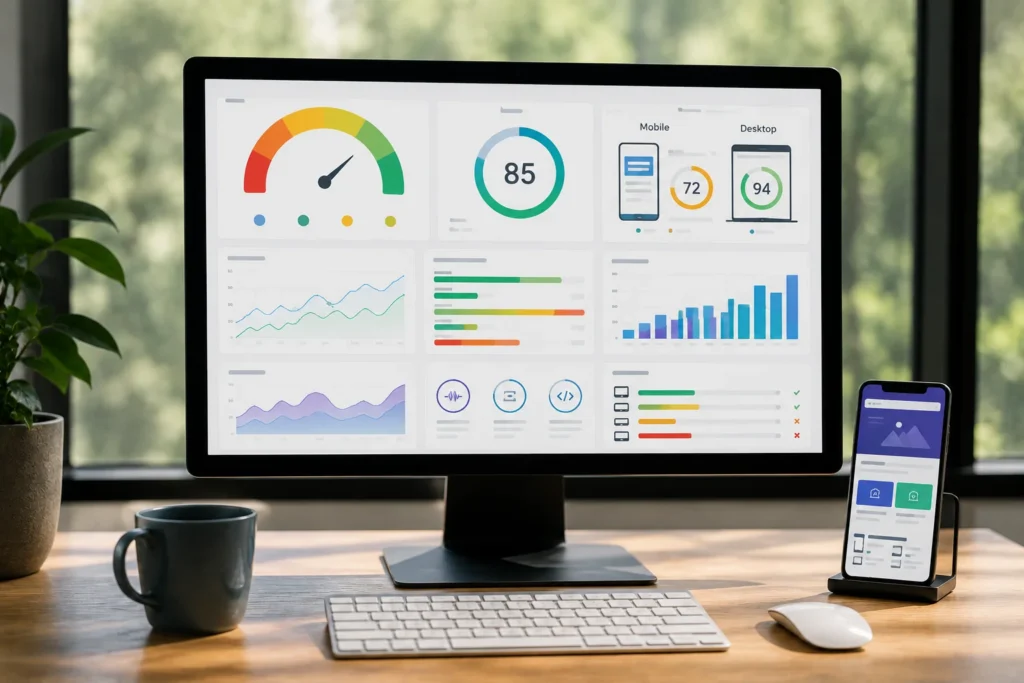
Quick test: Run your site through Google PageSpeed Insights (pagespeed.web.dev). Focus on the mobile score. Anything under 50 on mobile is actively hurting your rankings. Target 70+ as a minimum; 85+ is competitive.
Factor #15 | Impact: Very High
Local Content Depth and Topic Clusters
A single homepage with a brief services section does not build topical authority in a competitive Chicago market. The businesses ranking on page 1 for local service queries — and whose GBP prominence benefits from strong website authority — have built content depth across their sites.
What content depth means in practice:
- One page per service: Not a single ‘Services’ page listing everything, but individual dedicated pages per service — each targeting its own keyword, each with 600–1,200+ words of original content.
- Neighborhood location pages: Dedicated pages for each Chicago neighborhood or suburb served. Not template pages with swapped city names — pages with original content referencing local context, local landmarks, and neighborhood-specific customer concerns.
- FAQ and informational content: Pages that answer the questions customers ask before they hire — cost guides, comparison content, process explanations. These earn featured snippet placements and AI Overview citations, and they capture research-phase searchers who convert at high rates.
- Content clusters: Groups of interlinked pages around a topic — a pillar page covering the service broadly, supporting articles going deep on subtopics, neighborhood pages linking back to the pillar. This architecture signals topical authority to Google.
Category 5: Behavioral and Authority Signals
The final category covers the signals that are hardest to game and most reflective of genuine business quality: how real users interact with your listing, and how authoritative your business is in the eyes of the local web. In 2026, these signals carry increasing weight — Google is better than ever at detecting manufactured signals, which has raised the value of authentic authority.
Factor #16 | Impact: Very High
Local Backlinks
Backlinks from locally relevant sources remain one of the strongest prominence signals in Google’s local algorithm. For Chicago businesses, the quality and local relevance of links matters far more than quantity. A single mention in Crain’s Chicago Business outweighs 100 generic directory submissions.
Chicago-specific link opportunities ranked by authority and achievability:
- Chicago Chamber of Commerce: Member directory listing — high authority, relatively easy to obtain through membership.
- Neighborhood BID and SSA websites: Chicago’s 77 neighborhoods have active Business Improvement Districts and Special Service Areas, many with linked business directories. High local relevance, relatively low competition for inclusion.
- Local press: Chicago Tribune, Crain’s Chicago Business, Block Club Chicago, Chicago Reader, neighborhood publications. PR outreach targeting journalists covering your industry category.
- Event sponsorships: Chicago neighborhood festivals, charity events, and school fundraisers. Sponsorships earn contextual, locally relevant links from event websites.
- Local business associations: Industry associations with Chicago chapters, the Chicago SBDC, SCORE Chicago, neighborhood business alliances.
- Competitor backlink gap analysis: Use Ahrefs or Moz to identify sites linking to your top Chicago competitors but not to you. That list is your most targeted link acquisition roadmap.
In our experience, Chicago businesses that don’t have a single neighborhood-level backlink are leaving significant local pack authority on the table. A link from a Logan Square BID site to a business in Logan Square is worth more for local ranking in that neighborhood than a link from a high-DA national site with no local relevance.
Factor #17 | Impact: Critical
Behavioral Signals
Behavioral signals are user interaction metrics that Google interprets as quality and relevance indicators. In 2026, these have become increasingly important as Google gets better at detecting whether a business is genuinely serving its searchers well — or just technically optimized.
The behavioral signals Google watches for local businesses:
- Click-through rate on local pack listings: Does your GBP listing get clicked more or less often than its position would predict? A higher-than-expected CTR sends a positive ranking signal. Photo quality, review snippet content, and listing completeness all drive CTR.
- GBP call click rate: The percentage of profile viewers who click ‘Call.’ A high call rate signals that searchers find your listing compelling and credible.
- Direction request rate: Particularly relevant for brick-and-mortar Chicago businesses. High direction request rates signal strong local demand.
- Website engagement after click-through: Does traffic from your GBP listing bounce immediately, or do visitors engage with the page? Low bounce rate and high time-on-site from local search traffic are positive signals.
- ‘Back to search’ rate: How often users click your listing and then immediately return to the search results. A high back-to-search rate signals your page didn’t satisfy the query — a negative ranking signal.
Improving behavioral signals is not about gaming the system — it’s about genuinely improving the user experience. Better photos lead to higher CTR. Stronger review snippets make the listing more compelling. A faster website reduces bounce rate. The behavioral layer is the product of doing everything else correctly.
The most underappreciated behavioral signal: the review snippet Google shows under your business name in the local pack. Google automatically selects the most relevant snippet from your recent reviews. Reviews that contain service keywords and neighborhood names are more likely to be surfaced — another reason why keyword-rich review content matters beyond just ratings.
How Chicago’s Competition Changes Factor Weighting
The 17 factors above apply to all local businesses — but their relative importance shifts based on how competitive your specific Chicago category and neighborhood are. Understanding this helps you prioritize correctly.
| Competition Level | Example Categories | Highest-Impact Factors | Typical Timeline |
| Low | Specialty trades, niche B2B, unique retail | GBP completeness, NAP consistency, basic on-page | 2–4 months |
| Moderate | Accountants, family dentists, general contractors | Review velocity, content depth, GBP category | 4–6 months |
| High | HVAC, personal injury law, urgent care, real estate | Behavioral signals, local backlinks, review volume + recency | 6–12 months |
| Very High | Chicago SEO, financial advisors, high-volume home services | All 17 factors must be strong — no weak links | 12–18+ months |

In low-competition Chicago categories, getting GBP and NAP right is often enough to break into the local pack. In very high-competition categories, all 17 factors need to be strong — a single weak signal can be the difference between top 3 and page 2.
Frequently Asked Questions
What is the most important local SEO ranking factor in Chicago?
No single factor dominates — local SEO is a multi-signal system. That said, GBP primary category selection and review recency are the two factors we see producing the fastest measurable impact when corrected or improved. Primary category determines your search eligibility; review recency signals active business status. Together, they’re the highest-leverage starting point for most Chicago businesses.
Has Google’s local ranking algorithm changed in 2026?
The three core dimensions — relevance, proximity, and prominence — remain unchanged. What has evolved is how Google measures each. Behavioral signals carry more weight than they did in 2022. AI Overview integration has raised the value of structured, expert content. Review recency has become more important relative to raw volume. And entity consistency across the broader web has become a stronger prominence signal as Google’s Knowledge Graph has matured.
Do Google Business Profile posts directly improve rankings?
Not directly — posts are not a confirmed ranking factor in Google’s documented algorithm. However, they contribute indirectly: regular posting signals active profile management, adds indexed keyword content to your GBP, and drives user engagement (clicks, calls) that generates behavioral signals. Treat posts as a conversion and engagement tool that feeds behavioral ranking signals, not a ranking factor in itself.
How important are backlinks for local SEO in Chicago?
Very important — particularly for breaking into competitive Chicago categories where GBP and review signals are relatively equal among top competitors. Local backlinks (from Chicago neighborhood organizations, local press, industry associations) are often the differentiator between a business that’s stuck on page 2 and one that holds the top local pack position. For lower-competition categories, strong GBP and review signals may be sufficient without significant link building.
Does website speed affect local pack rankings?
Yes, though primarily through the prominence pathway. Core Web Vitals are confirmed ranking factors for organic results. For local pack rankings, page speed affects behavioral signals: a slow website generates more bounce-backs from GBP clicks, which sends negative engagement signals. Fast websites keep visitors engaged after they click through from the local pack — a positive signal that feeds back into GBP ranking.
How do behavioral signals work in local SEO?
Google monitors how users interact with local search results: click-through rate on map pack listings, call click rate, direction requests, website engagement after GBP click-through, and ‘back to search’ rate. Listings that generate stronger engagement than their position would predict receive positive ranking signals. You improve behavioral signals by improving the quality of your listing presentation — better photos, stronger review snippets, more compelling meta descriptions — not by artificially inflating click counts.
Can I rank in the Chicago local pack without a website?
Technically yes. A GBP listing without a website can appear in the local pack if GBP and review signals are strong enough. However, in competitive Chicago categories, businesses without websites consistently lose ground to those with optimized sites, because a website provides additional relevance signals (content, schema, on-page keywords), prominence signals (domain authority, backlinks), and behavioral signals (engaged post-click traffic) that GBP alone cannot generate.
How do I know which ranking factors to fix first?
Start with a diagnostic audit. Check your GBP primary category against your top-ranking competitors. Run a NAP consistency audit. Check your title tags and H1s. Run Google PageSpeed Insights on your main service pages. Review your last 90 days of GBP Insights data. The combination of these five checks will surface your highest-impact, fastest-return opportunities without guesswork.
Is local SEO different for Chicago neighborhoods vs the city broadly?
Yes — neighborhood-level local SEO is a distinct layer within Chicago market strategy. The local pack for ‘plumber Lincoln Park’ is a different competitive set than ‘plumber Chicago.’ Neighborhood-specific searches often have lower competition and higher conversion rates because they reflect hyper-local intent. The ranking factors are the same, but the competitive threshold is lower, which means neighborhood-level optimization often produces faster results than competing for broad city-wide terms.
What is entity SEO and why does it matter for Chicago local rankings?
Entity SEO is the practice of making your business a clearly defined, well-connected entity in Google’s Knowledge Graph. When Google has high confidence in your business entity — consistent name, verified location, corroborating mentions across authoritative sources — it ranks your listing more prominently and more stably. Entity signals include consistent NAP across all web properties, a verified GBP linked to your website, active social profiles with matching information, and mentions in authoritative Chicago sources. Businesses with strong entity signals hold local pack positions more durably than those relying on a single strong signal.
Know Your Factors — Now Let’s Fix Them

Understanding the 17 ranking factors is step one. Step two is knowing which ones your business needs to fix first — and executing in the right order. For most Chicago businesses, the gap between current performance and page 1 comes down to 3–4 specific signals, not all 17.
Zolqix Digital provides free local SEO audits that identify exactly which factors are holding your Chicago business back and give you a prioritized action plan to fix them.
Get Your Free Chicago Local SEO Audit
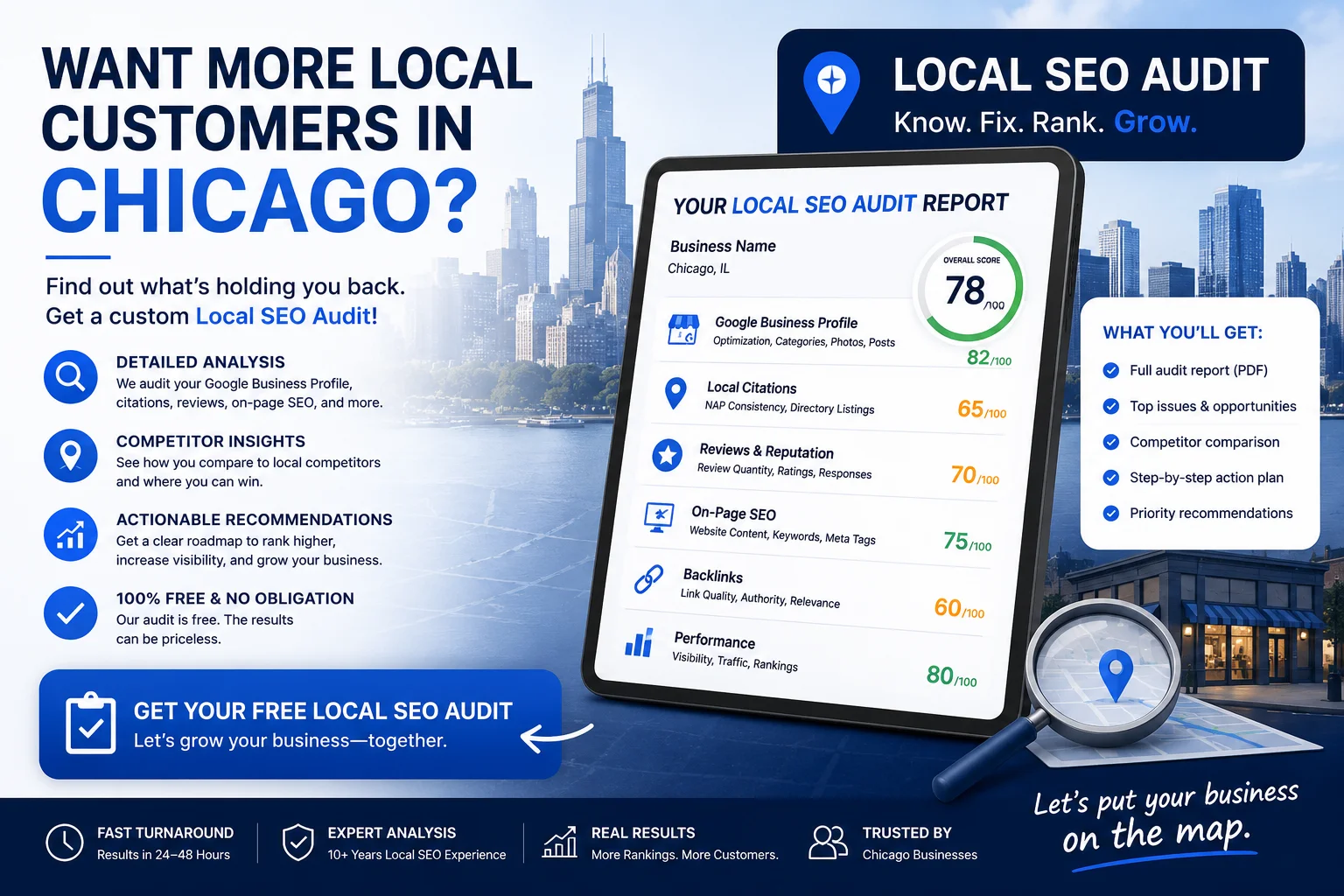
We’ll audit all 17 ranking factors for your business — GBP, reviews, citations, on-page SEO, backlinks, technical health, and behavioral signals — and give you a clear priority list. Delivered within 48 hours. No obligation.
Request Your Free Audit at zolqix.com
Schedule a Free Local SEO Strategy Call
Talk to a Chicago local SEO specialist about your category, your competitors, and the specific factors most likely to move your rankings.
Book Your Free 30-Minute Call at zolqix.com
Questions? Contact us at hello@zolqix.com or visit zolqix.com
Written by
zolqix — Zolqix
Digital marketing team running local SEO, Google Ads, and growth campaigns for Chicago-area businesses. We write from what we see in active accounts.
Free — $500 value
Ready to rank
in Chicago?
Get a written audit showing exactly what’s holding back your local rankings. No call. No pitch.
No credit card • Written report within 24 hours • No obligation