
Local SEO in Chicago is not the same as local SEO in a mid-size market. You’re competing against thousands of businesses in one of the most-searched metro areas in the country — a city where a roofing company in Bridgeport and one in Edgewater might as well be in different towns from Google’s perspective.
In our experience optimizing Chicago businesses across categories like home services, healthcare, law, and real estate, one thing is consistently true: the companies showing up in Google’s local pack aren’t necessarily the best-reviewed or the longest-established. They’re the ones that built their local SEO infrastructure correctly and maintained it.
This guide covers everything: what local SEO is, how Google’s local algorithm works in 2026, the ranking factors that actually move results, realistic timelines, cost ranges, advanced tactics most agencies won’t tell you about, and a step-by-step 30-day launch plan.
What Is Local SEO — And Why Chicago Is Different
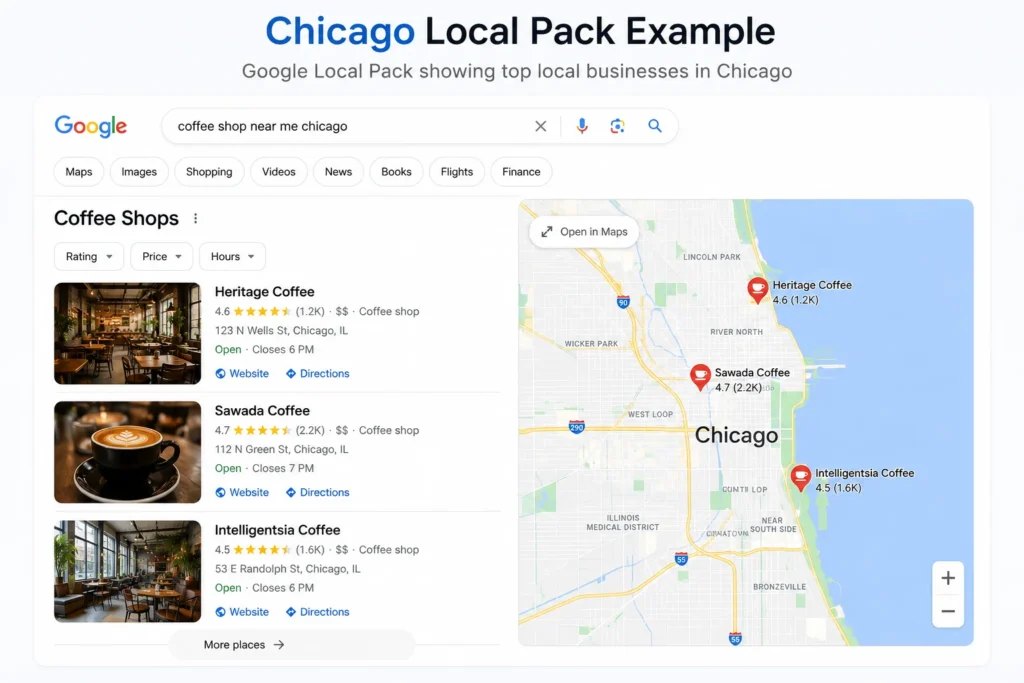
Local SEO is the discipline of optimizing a business’s online presence so it appears prominently in location-based search results. This includes three surfaces:
- The Local Pack (Map Pack): The 3-business block with a map that appears above organic results for most local searches. Highest click-through rate — typically captures 35–45% of clicks on local queries.
- Google Maps: Where customers search when they’re already ready to act. Increasingly, Maps functions as a standalone discovery engine, separate from Google Search.
- Local Organic Results: The web results beneath the map pack. These capture commercial-intent searchers who scroll past the pack or are doing research before deciding.
For a Chicago small business, all three matter. But here’s what makes Chicago different from a typical metro:
Neighborhood-Level Competition
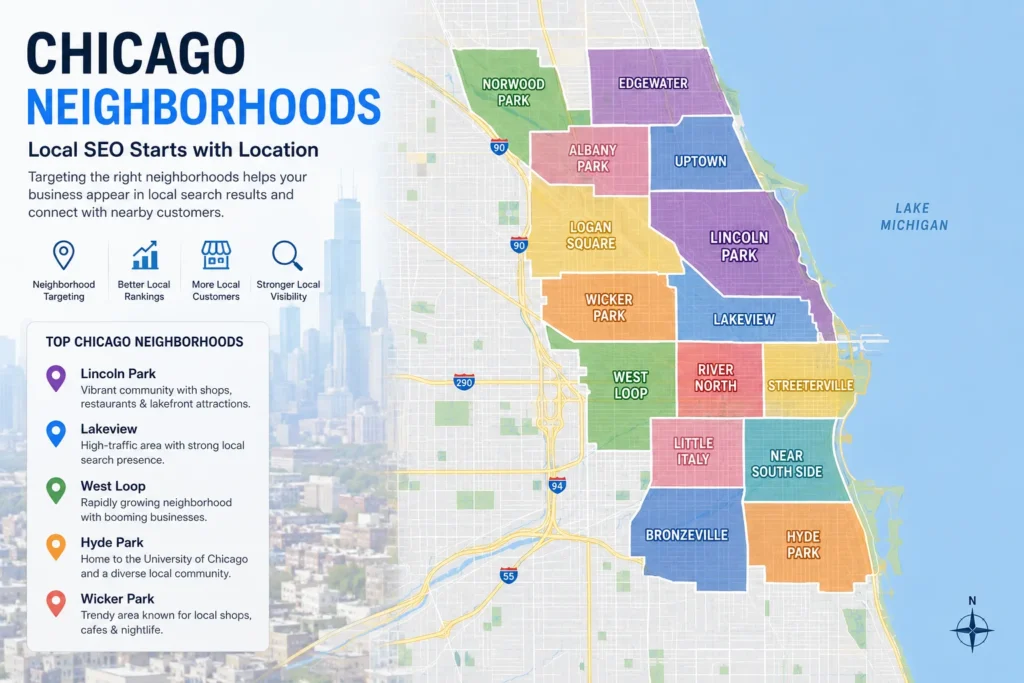
Chicago is a city of 77 officially recognized neighborhoods, and Chicagoans search by neighborhood. ‘Dentist River North,’ ‘HVAC Logan Square,’ ‘personal injury attorney Wicker Park’ are real, high-intent queries. A business optimized only for ‘Chicago’ is invisible to a large portion of its potential customers.
In our audits of Chicago businesses, we routinely find that neighborhood-level keyword opportunities are the most underserved — and the most achievable. The competition for ‘plumber Logan Square’ is far thinner than ‘plumber Chicago,’ and the user is just as ready to call.
Business Density and Review Expectations
In competitive categories — attorneys, HVAC, dentists, real estate, home services — the Chicago market has dozens of well-optimized listings competing for three map pack spots. A business with 40 reviews looks thin in this environment. Businesses consistently holding top-3 positions in high-competition Chicago categories tend to have 200–500+ reviews with strong recency.
Proximity Weight in a Dense Market
Google’s local algorithm weights proximity heavily. In a densely packed city like Chicago, this means a business in the South Loop isn’t automatically competitive for searches happening in Lincoln Square. Understanding your actual service radius — and how Google’s proximity signals interact with your GBP location — is foundational strategy, not an afterthought.
How Google’s Local Ranking Algorithm Works in 2026
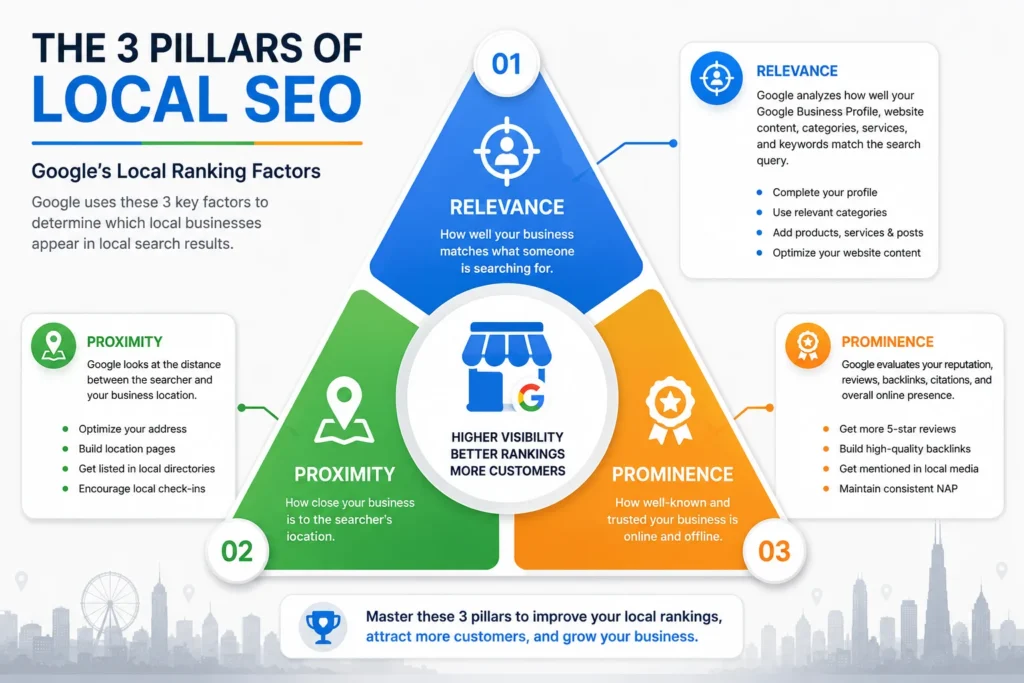
Google’s local ranking algorithm evaluates businesses on three core dimensions. These haven’t changed, but the weight and interpretation of each has evolved significantly.
1. Relevance
How well does your business match what the searcher is looking for? Relevance is determined by:
- Your GBP primary and secondary categories
- Services listed on your GBP and website
- Keywords in your business description, posts, and review responses
- The topical depth of your website content
- Schema markup that confirms your service types to Google
One common mistake we repeatedly see: businesses set their GBP primary category to the broadest available option (‘Contractor,’ ‘Cleaning Service,’ ‘Lawyer’) rather than the most specific one that describes their core service. Category selection is the single highest-leverage GBP optimization — and it’s often wrong.
2. Proximity
How physically close is the business to the searcher (or to the location specified in the search query)? Proximity is largely outside your control — you can’t change where your business is located. But you can influence how Google interprets your service area.
For service-area businesses (plumbers, cleaners, mobile services), the strategy is different: hide your physical address, define your service area precisely, and build location-specific content for each neighborhood or suburb you serve.
3. Prominence
How well-known and authoritative is the business online? Prominence signals include:
- Review count and average rating on Google
- Review velocity (how recently you’re getting new reviews)
- Citation count and NAP consistency across directories
- Backlink profile — especially links from local sources
- Website authority and on-page optimization
- Behavioral signals: click-through rates, phone calls, direction requests
In 2026, prominence has become more behavioral. Google watches how users interact with results. A business that gets clicked, visited, and called sends stronger ranking signals than one that ranks but gets ignored. This means your GBP presentation — photos, reviews, business description — is a ranking factor, not just a conversion factor.
Google Business Profile: The Highest-Leverage Asset in Local SEO
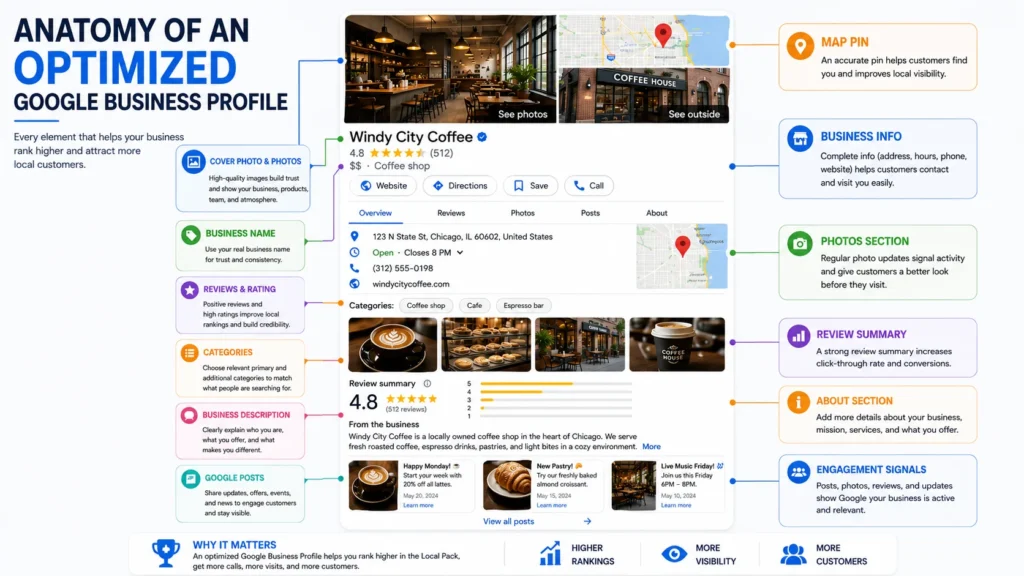
If you only do one thing for local SEO, optimize your Google Business Profile. To see these best practices in action, visit our Google Business Profile and explore how we maintain our listing with customer reviews, business photos, services, and regular updates. In our experience, a fully optimized GBP outperforms a mediocre one with 3x the reviews—the profile quality gap is that significant.
Primary Category Selection
This is the most important field in your GBP. Your primary category determines which search queries you’re eligible to rank for. Research what categories your top local pack competitors use — not what sounds most logical to you.
A Chicago cleaning company listed as ‘Cleaning Service’ instead of ‘House Cleaning Service’ loses eligibility for residential cleaning searches. A physical therapist listed as ‘Medical Center’ instead of ‘Physical Therapist’ misses the queries they actually want. We’ve seen primary category corrections produce local pack movement within 3–4 weeks.
Business Description Optimization
Your GBP description (750 characters) is not a mission statement. It’s a relevance signal. Write it to include:
- Your primary service or category in the first sentence
- 2–3 secondary services you want to rank for
- Your city and 1–2 key neighborhoods or suburbs you serve
- A differentiator (years in business, certifications, specialties)
- A light call to action
Photo Strategy
GBP photos influence both rankings (behavioral signals — profiles with more photos get more clicks and calls) and conversion. Photos added within the last 90 days are weighted more heavily. A profile with a single stock photo from 2021 is losing ground to competitors who upload new images monthly.
Photo types that consistently perform well in our Chicago client accounts:
- Exterior photos: Your storefront or office, especially with street-visible signage. Helps Google confirm your physical location.
- Team photos: Real people build trust. Named team photos outperform generic headshots.
- Work-in-progress or completed work: Before/after for trades, in-office for professional services, product shots for retail.
- Neighborhood context: Photos that establish you as part of the Chicago community — local events, neighborhood landmarks.
Google Posts Strategy
Google Posts are underused by most Chicago businesses. Consistent posting (2–4 per month) signals active management to Google and gives you additional keyword-rich content indexed to your profile.
Post types that generate engagement:
- Offer posts: Time-limited promotions. ‘Free estimate this month’ gets clicks.
- Update posts: New service, new team member, new hours. Keep your profile current.
- Event posts: If you’re sponsoring or hosting anything local, this is high-value for community signals.
UTM Tracking for GBP
One detail most agencies skip: add UTM parameters to your GBP website link. This lets you track exactly how much traffic and how many conversions come from your Google Business Profile — separate from organic search.
You can also generate properly formatted tracking URLs using Google’s Campaign URL Builder.
Add this to your GBP website URL in the profile settings. It takes 60 seconds and gives you data most businesses never have.
Q&A Section Management
The Q&A section on your GBP is indexed by Google and appears in your profile. Seed it proactively with questions your customers actually ask — and answer them yourself. Left unmanaged, anyone can post questions and answers, including competitors.
Local SEO Ranking Factors: What Actually Moves Results in 2026
Here’s a prioritized breakdown of the factors with the most practical impact for Chicago businesses right now.
Review Signals — Volume, Recency, Sentiment
Reviews remain one of the most powerful local ranking signals. But the nuance matters:
- Volume: More reviews generally improve rankings, but after a threshold (~50+ reviews), the marginal benefit of each additional review decreases. Recency becomes more important.
- Recency: A review from last week carries more weight than one from 18 months ago. Google wants to surface businesses that are currently active and trusted — not just historically well-reviewed.
- Sentiment and keyword content: Reviews that organically mention your service, city, and neighborhood add topical relevance to your profile. ‘Great HVAC service in Lincoln Park’ is a more powerful review than ‘Five stars — highly recommend.’
- Response rate: Responding to reviews — including negative ones — is a trust signal. It also gives you another opportunity to include relevant keywords naturally.
For Chicago businesses: aim for a new review every 10–14 days as a baseline. In competitive categories, the map pack leaders often have weekly review cadence.
Review Generation Systems
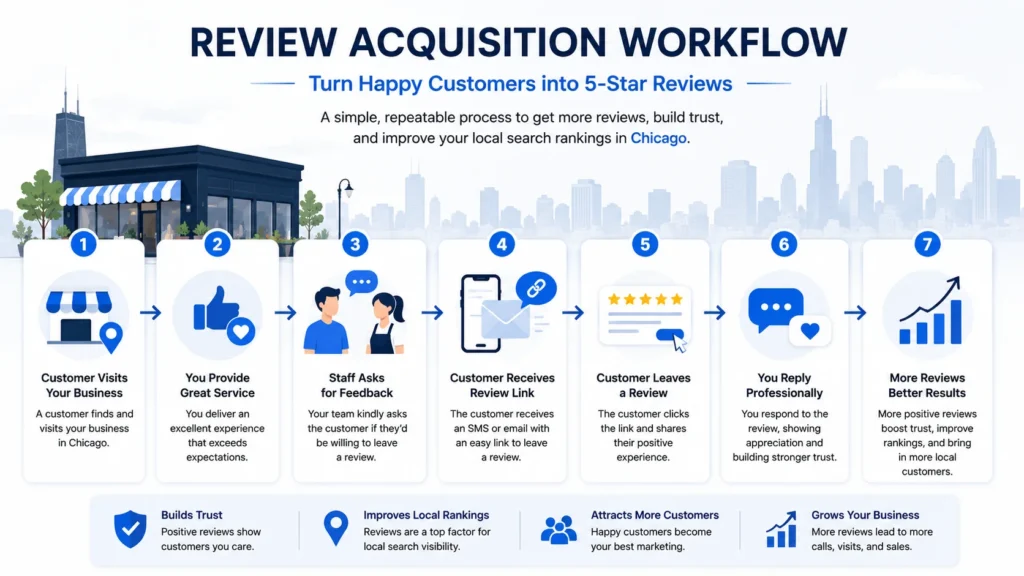
The businesses that win on review volume have systems, not spontaneous goodwill. A practical system that works:
- Deliver the service or product.
- Send a follow-up text or email within 24 hours with a direct Google review link (use your GBP short link).
- If no review after 5 days, send one follow-up.
- Train your team to verbally ask at the end of every positive interaction.
In our experience, businesses that implement this system see 3–5x their previous review velocity within 60 days. The ask is the step most businesses skip.
⚠️ What NOT to do: Never offer incentives for reviews. Never use kiosk-style review stations at your location (Google flags these). Never buy reviews. All of these risk profile suspension — which in a local business context is catastrophic.
Local Citations and NAP Consistency
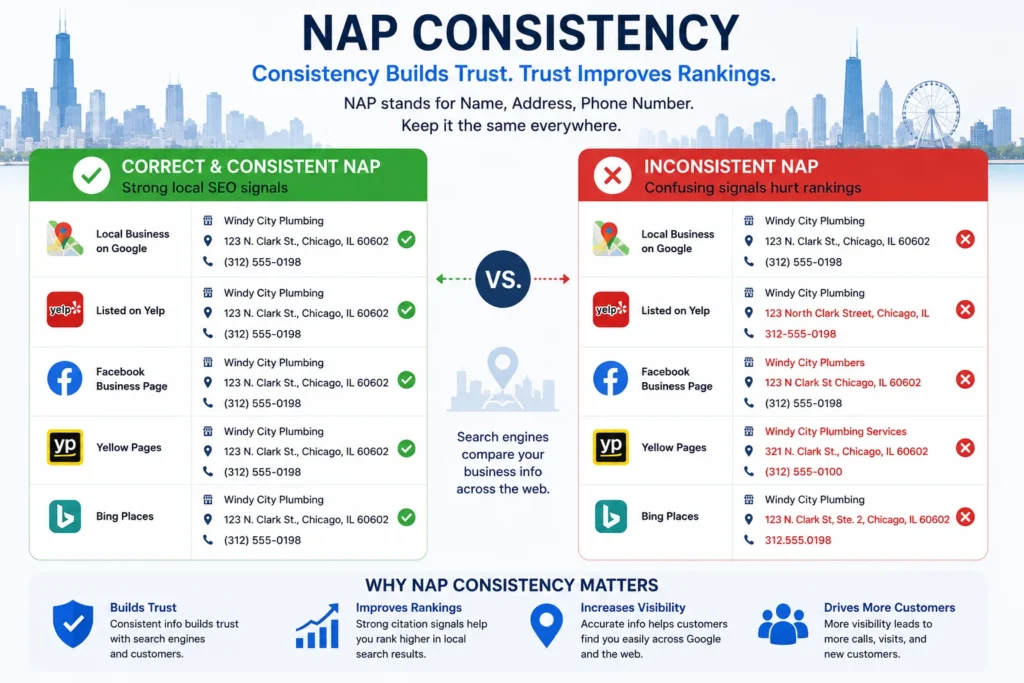
A citation is any mention of your business name, address, and phone number online. Tools like BrightLocal and Whitespark can help you audit your citations, identify inconsistencies, and monitor your local listings more efficiently. NAP inconsistencies — old addresses, wrong phone numbers, name variations — create trust ambiguity that suppresses rankings.
Citation priority for Chicago businesses:
| Tier | Platforms | Priority |
| Tier 1 — Critical | Google, Apple Maps, Bing, Yelp, Facebook | Fix first — these are the most indexed |
| Tier 2 — Aggregators | Data Axle, Neustar Localeze, Foursquare | Fixes cascade to hundreds of directories |
| Tier 3 — Industry-specific | Houzz, Healthgrades, Avvo, Angi (by category) | Important for niche relevance |
| Tier 4 — Local Chicago | Chicago Tribune directories, CMAP, neighborhood org sites | High-value for local authority |
On-Page Local Signals
Your website is a ranking factor for both local organic results and — through prominence signals — the map pack. Key on-page elements:
- Location pages: If you serve multiple Chicago neighborhoods or suburbs, build dedicated pages for each area with original content, local references, and specific service information. Don’t swap city names in boilerplate — Google detects thin location pages.
- NAP in footer: Your name, address, and phone number in the site footer, matching your GBP exactly. Even minor variations (St. vs Street, Suite vs Ste.) create inconsistency signals.
- LocalBusiness schema: JSON-LD structured data confirming your business type, location, hours, and contact information. This is a direct relevance signal to Google’s knowledge graph.After implementing your LocalBusiness schema, validate it using Google’s Rich Results Test to ensure your structured data is error-free and eligible for enhanced search results.
- Title tags and header hierarchy: Each location page should have a unique title tag following the pattern: [Service] in [Chicago Neighborhood] | [Brand].
- Page speed / Core Web Vitals: Slow sites lose organic ground to faster competitors. On mobile—where most local searches happen—a site that loads in 4 seconds loses users before they ever see your value proposition. Use Google’s PageSpeed Insights to test your website’s performance and identify opportunities to improve Core Web Vitals.
Local Link Building
Backlinks from locally relevant sources remain one of the strongest local authority signals. For Chicago businesses, the highest-value link opportunities include:
- Chicago neighborhood organization websites: Most of Chicago’s 77 neighborhoods have active business improvement districts (BIDs), SSAs (Special Service Areas), or neighborhood association sites that accept business listings and feature member spotlights.
- Local press and media: Chicago Tribune, Crain’s Chicago Business, Block Club Chicago, and neighborhood-specific publications. A single mention in a credible Chicago outlet is worth dozens of generic directory links.
- Sponsor local events: Chicago Neighborhood Alliance events, local festivals, community fundraisers. Sponsorships typically earn a link from the event website — a local, contextually relevant citation.
- Chicago Chamber of Commerce and SBDC: The Chicago Chamber and Chicago SBDC both maintain member directories. These are high-trust, locally relevant citations and backlinks.
- Competitor gap analysis: Use a tool like Ahrefs or Moz to identify sites linking to your top local competitors but not to you. This gap list is your most targeted link acquisition roadmap.
Behavioral Signals and CTR Optimization
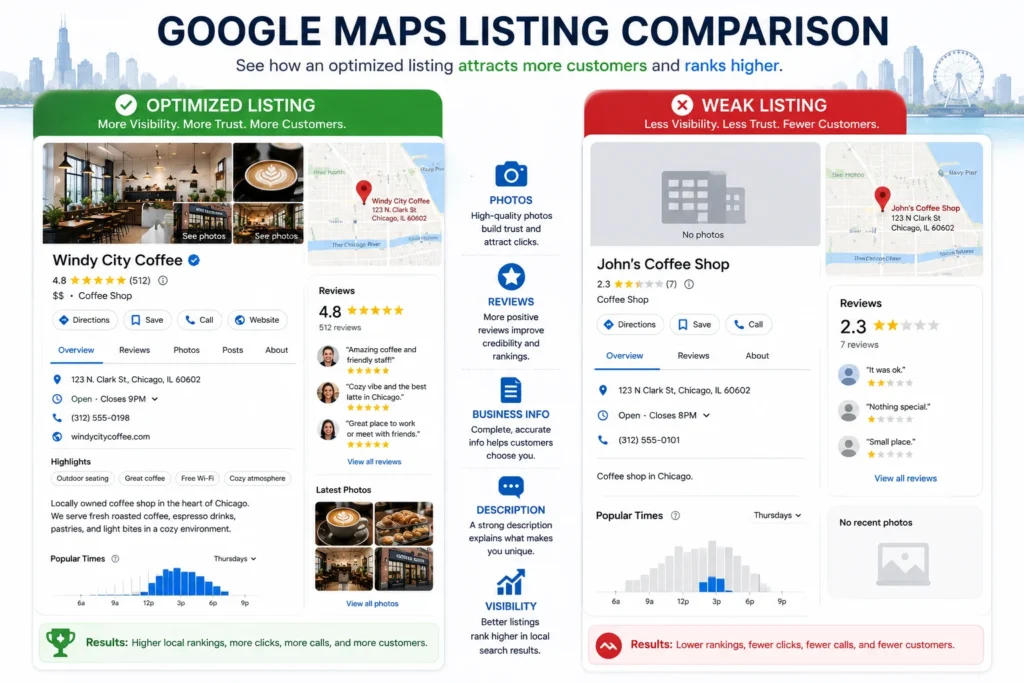
This is the factor most local SEO guides underweight. Google’s algorithm watches how users interact with search results — click-through rate, call clicks, direction requests, website visits, time on site, and bounce-back rate. A business that consistently attracts more interactions than its position would predict gets a positive signal.
Ways to improve behavioral signals without gaming the system:
- GBP photos: Profiles with 100+ photos get significantly more views and clicks than those with fewer than 10. Photos are behavioral signal amplifiers.
- Review quality: Detailed, specific reviews with keywords make your listing more compelling in the map pack. The snippet Google shows under your business name comes from recent reviews.
- Meta title and description optimization: For local organic, the CTR on your page listing affects organic rankings. Write meta descriptions that answer the search query and include a reason to click.
- Local service area specificity: A GBP business description that says ‘serving Logan Square, Bucktown, and Wicker Park’ is more relevant — and more clickable — to a Logan Square searcher than one that says ‘serving the Chicago area.’
AI Overviews and Their Impact on Chicago Local SEO
Google’s AI Overviews (formerly Search Generative Experience) rolled out to most queries in 2025 and fundamentally changed how information appears in search results for some categories. For local SEO, the impact is nuanced.
What AI Overviews Mean for Local Search
For high-intent local queries — ‘plumber near me,’ ‘best Italian restaurant in Lincoln Park,’ ’emergency dentist Chicago’ — AI Overviews have had limited impact. These queries still resolve to traditional map packs and local results, because Google recognizes they require current, location-specific data that AI summaries can’t reliably provide.
Where AI Overviews matter more for local businesses: informational queries that precede a local search. ‘How much does a roof replacement cost in Chicago?’ or ‘What should I look for in a home care agency?’ These are research queries that now often get an AI-generated summary at the top — and if your content isn’t cited in that summary, you lose the traffic.
How to Get Cited in AI Overviews
Based on patterns we’ve observed across AI Overview citations:
- Structured, specific answers to common questions outperform vague, general content
- FAQ sections with direct Q&A format are frequently pulled into AI summaries
- Content with specific local context — Chicago references, neighborhood specifics — is favored for locally relevant AI Overviews
- E-E-A-T signals: content attributed to named experts with verifiable credentials gets prioritized
- Schema markup, especially FAQPage and HowTo schema, improves AI crawlability
Strategic implication: The best defense against AI Overview traffic loss is becoming the source Google pulls from. Write content that directly answers the questions your customers ask before they search for you — and structure it clearly enough that Google can extract the answer and attribute it to you.
Local Entity Optimization: The Advanced Layer
Google’s knowledge graph understands search as a network of entities — businesses, locations, people, concepts — and the relationships between them. Local entity optimization is the practice of making your business a clearly defined, well-connected entity in that graph.
What Entity Optimization Involves
- Consistent business name across all web properties (exact match — no variations)
- Verified Google Business Profile connected to your website
- Wikipedia or Wikidata entry (for established businesses — not applicable to all)
- Mentions in authoritative local sources that Google already trusts
- Consistent use of business name, address, and key identifiers in structured data
- Social profiles (LinkedIn, Facebook, Instagram) with matching NAP
The practical goal: when Google crawls mentions of your business name, it should find consistent, corroborating signals across multiple authoritative sources. This builds entity confidence — which translates directly into GBP prominence and local organic authority.
Service-Area Business (SAB) Optimization in Chicago
If your business goes to the customer rather than the customer coming to you — HVAC, cleaning, plumbing, mobile car detailing, home health care, landscaping — your local SEO strategy differs in important ways.
SAB-Specific Strategy
- Hide your address on GBP: Service-area businesses should typically hide their physical address (often a home address or non-customer-facing location) and define service area zones instead.
- Define service areas precisely: List your actual service areas in GBP — neighborhoods, zip codes, or suburbs — not just ‘Chicago.’ Vague service areas reduce proximity relevance.
- Build neighborhood content: Create location-specific pages or blog content for each major neighborhood you serve. ‘Plumbing Services in Lincoln Park,’ ‘HVAC Repair in Evanston.’ These pages rank for neighborhood-level queries and send location relevance signals to Google.
- Earn local reviews that mention neighborhoods: Encourage customers to mention their location in reviews when asking for feedback. ‘Best AC service I’ve found in Andersonville’ is extremely valuable.
Spam Fighting and GBP Redressal
One of the most underrated tactics in competitive Chicago markets is identifying and reporting fake or policy-violating competitor listings. In high-competition categories, GBP spam is common:
- Keyword-stuffed business names: Listing names like ‘Best Chicago Plumber 24/7 Emergency LLC’ violate Google’s guidelines. Real business names should not contain keyword phrases.
- Fake addresses: Competitors listing addresses at virtual offices, UPS stores, or addresses they don’t actually operate from.
- Duplicate listings: The same business appearing multiple times for the same location.
- Suspended listings reappearing: Some spammers repeatedly recreate suspended profiles.
How to report: Use Google’s Business Redressal Complaint Form and the ‘Suggest an edit’ function on the offending listing. In our experience, clear-cut guideline violations (keyword-stuffed names, obviously fake addresses) get actioned within 2–8 weeks with a well-documented report.
This isn’t a tactic to abuse — only report genuine violations. But in markets where one or two spammy listings are holding your legitimate business out of the top 3, redressal can shift the map pack without any change to your own profile.
Mobile-First Search and Voice Search in Chicago
Mobile-First Local Search Behavior
More than 60% of local searches in Chicago happen on mobile devices — and mobile searchers behave differently from desktop users. They’re looking for immediate answers, they’re often physically in the city when searching, and they have lower tolerance for slow or clunky experiences.
Mobile-first local SEO requirements:
- Page load time under 2.5 seconds on mobile (test with Google PageSpeed Insights)
- Click-to-call phone number visible above the fold without scrolling
- Google Maps embed on contact page (not just a static address)
- Tap-friendly buttons and navigation — no tiny links
- No interstitials or pop-ups that block content immediately on page load
Voice Search Optimization
Voice search queries are conversational and question-based. ‘Hey Google, who’s the best HVAC company near me?’ or ‘Find an emergency dentist open now in Chicago.’ To capture these:
- FAQ content: Voice search almost always pulls answers from FAQ-style content with direct, conversational answers.
- ‘Near me’ optimization: Include ‘near me’ language in your GBP description and page content — Google connects ‘near me’ queries to proximity-verified businesses.
- Conversational keyword phrases: Supplement your head terms with long-tail, question-based variants: ‘who fixes furnaces in Lincoln Park,’ ‘what time does [business] open in Chicago.’
Local Content Clusters and Topical Authority
A single optimized service page is not enough to build topical authority in a competitive Chicago market. The businesses that dominate local organic results in 2026 have built content clusters — groups of interconnected pages that together signal deep expertise on a topic and geography.
What a Local Content Cluster Looks Like
For a Chicago HVAC company, a content cluster might include:
- Pillar page: ‘HVAC Services Chicago — [Company Name]’ — comprehensive service page
- Cluster page 1: ‘How Much Does AC Replacement Cost in Chicago?’ — informational
- Cluster page 2: ‘Best Time to Replace Your Furnace in Chicago’ — seasonal content
- Cluster page 3: ‘AC Repair vs Replacement: What Chicago Homeowners Need to Know’ — commercial
- Neighborhood pages: ‘HVAC Services in Lincoln Park,’ ‘HVAC Services in Wicker Park,’ etc.
- FAQ page: Targeting People Also Ask results for HVAC queries in Chicago
Each page links to related pages in the cluster. This internal linking strategy concentrates relevance and authority, signaling to Google that this website is a comprehensive resource on HVAC in Chicago — not just one page with keywords on it.
Realistic Timeline: When Does Local SEO Work?
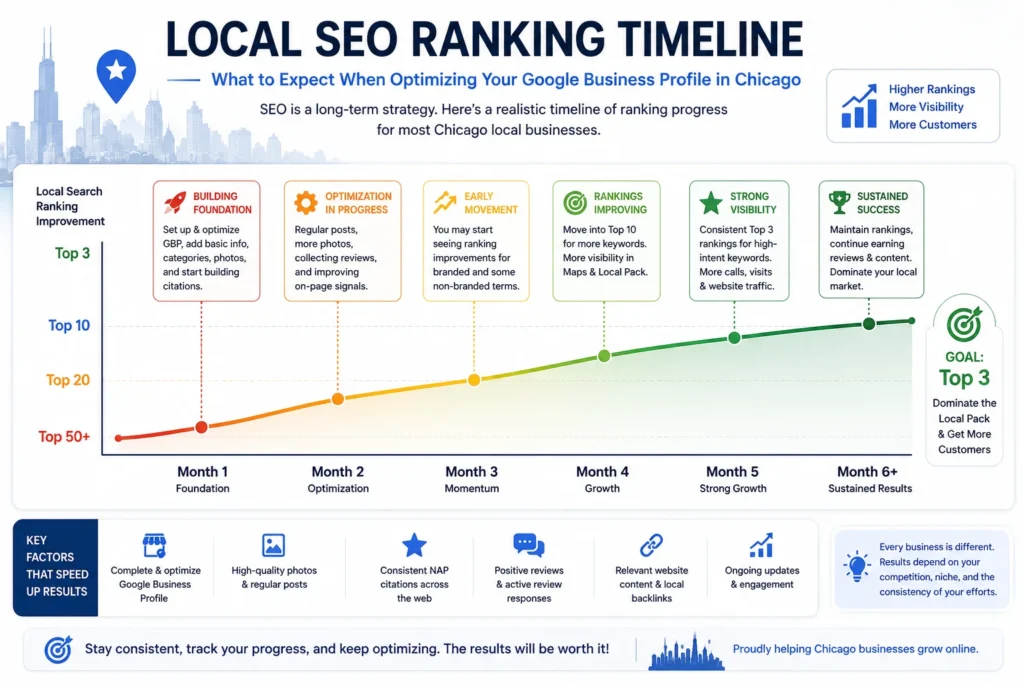
The honest answer: it depends on your starting point, your category, and how competitive your specific Chicago neighborhood is.
| Starting Situation | Typical Timeline to Results | Key Bottleneck |
| New GBP, no reviews, no citations | 4–6 months to first meaningful rankings | Review and citation foundation |
| Existing GBP, some reviews, needs optimization | 6–10 weeks for first movement | Category and profile corrections |
| Established business, weak website | 3–6 months for organic lift | Website content and technical SEO |
| High-competition category (attorneys, contractors) | 6–12 months for sustained local pack | Review velocity, link authority, content volume |
| Service-area business entering new neighborhood | 2–4 months with dedicated content + reviews | Neighborhood-specific content and reviews mentioning area |
Local SEO compounds over time. The businesses that have been working it consistently for 18–24 months are very hard to displace. The ones that struggle are those who start, see partial results, pause, and restart 6 months later — losing the compounding they built.
What Local SEO Costs in Chicago
Local SEO pricing reflects the competitiveness of the market and the scope of work. Here’s a realistic breakdown:
| Option | Monthly Cost | What You Get | Best For |
| DIY / In-house | $50–200 (tools) | Your time (5–10 hrs/mo) + tools like BrightLocal | Lean budgets, hands-on owners |
| Freelancer | $500–1,500 | GBP management, basic citations, monthly reporting | Low-to-mid competition categories |
| Local SEO Agency (mid-tier) | $1,000–2,500 | Full management: GBP, citations, content, link building, reporting | Competitive markets, growth-focused businesses |
| Premium Agency | $2,500–5,000+ | Full-service + local PR, content clusters, technical SEO | High-competition Chicago categories |
⚠️ Beware of $99/month local SEO packages. The math doesn’t work in a market like Chicago. The labor required to do local SEO properly — GBP management, citation work, content, reporting — costs more than that to deliver. If you’re paying $99/month, you’re getting automated directory submissions and nothing more.
The right question isn’t ‘what’s the cheapest option?’ — it’s ‘what’s my revenue per new customer, and what would 2–5 more customers per month be worth?’ For most Chicago small businesses, one or two additional clients per month from local search easily justifies $1,500–2,500/month in agency spend.
How to Start: Your 30-Day Local SEO Action Plan
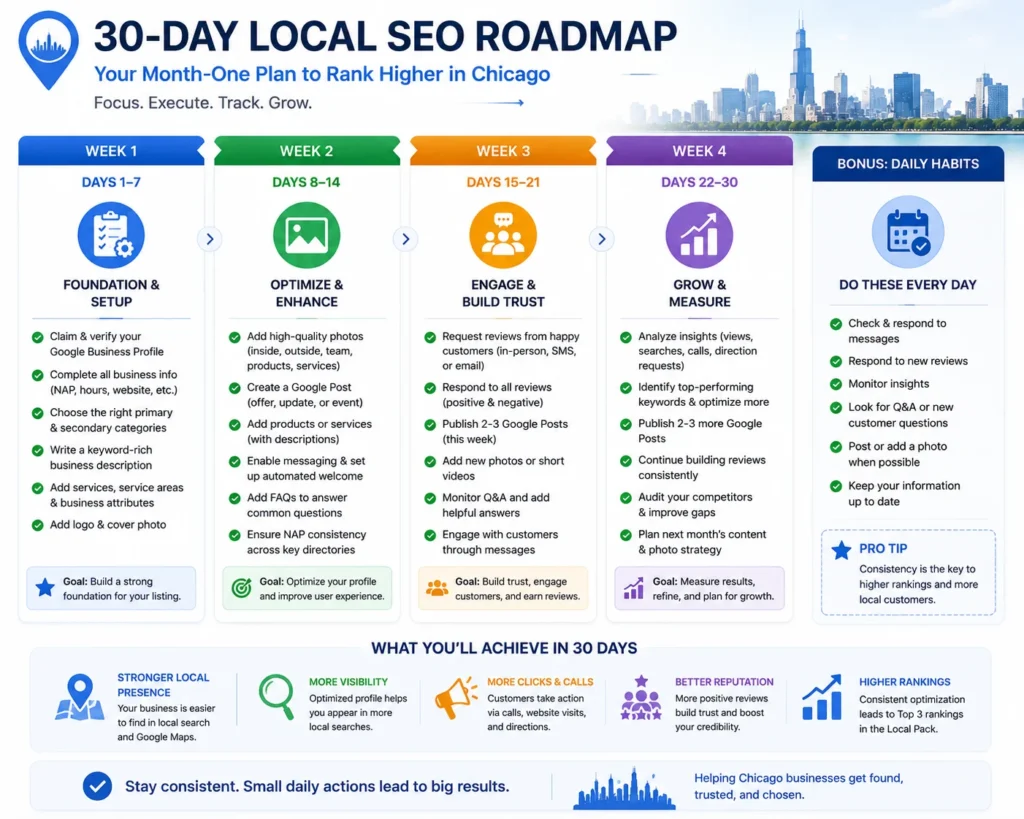
You don’t need to do everything at once. Here’s a sequenced 30-day plan for a Chicago small business starting from scratch or correcting a neglected presence.
Week 1 — GBP Foundation
- Verify ownership of your Google Business Profile (or claim it if unclaimed)
- Audit and correct your primary category — research competitor categories first
- Complete every field: description, services, attributes, hours, website, phone
- Upload 15–20 high-quality photos (exterior, interior, team, work)
- Add UTM parameters to your GBP website link
- Seed the Q&A section with 5–8 common questions — answered by you
- Enable messaging and set a response expectation
Week 2 — Citation Cleanup
- Run a free citation audit (BrightLocal free trial or Whitespark)
- Fix NAP inconsistencies on Tier 1 platforms: Google, Yelp, Facebook, Apple Maps, Bing Places
- Update Tier 2 aggregators: Data Axle, Neustar Localeze, Foursquare
- Claim and complete your Chicago Chamber of Commerce listing if applicable
- Fix any duplicate GBP listings — merge or delete
Week 3 — Review Acquisition Launch
- Compile a list of your last 20–30 customers
- Send a personalized review request with your direct GBP review link
- Set up a review follow-up sequence (email or SMS, 5 days after delivery)
- Brief your team on verbally asking for reviews at point of service
- Respond to every existing review — positive and negative
Week 4 — Website and Technical Audit
- Run a mobile speed test (Google PageSpeed Insights) — target score 70+ on mobile
- Verify NAP in footer matches GBP exactly
- Check that LocalBusiness schema is implemented correctly (Google Rich Results Test)
- Audit your service pages — does each core service have a dedicated page?
- Identify the top 3 Chicago neighborhoods you want to rank in — plan location pages
[ VISUAL: Local SEO 30-day workflow diagram — week-by-week task breakdown with timeline ]
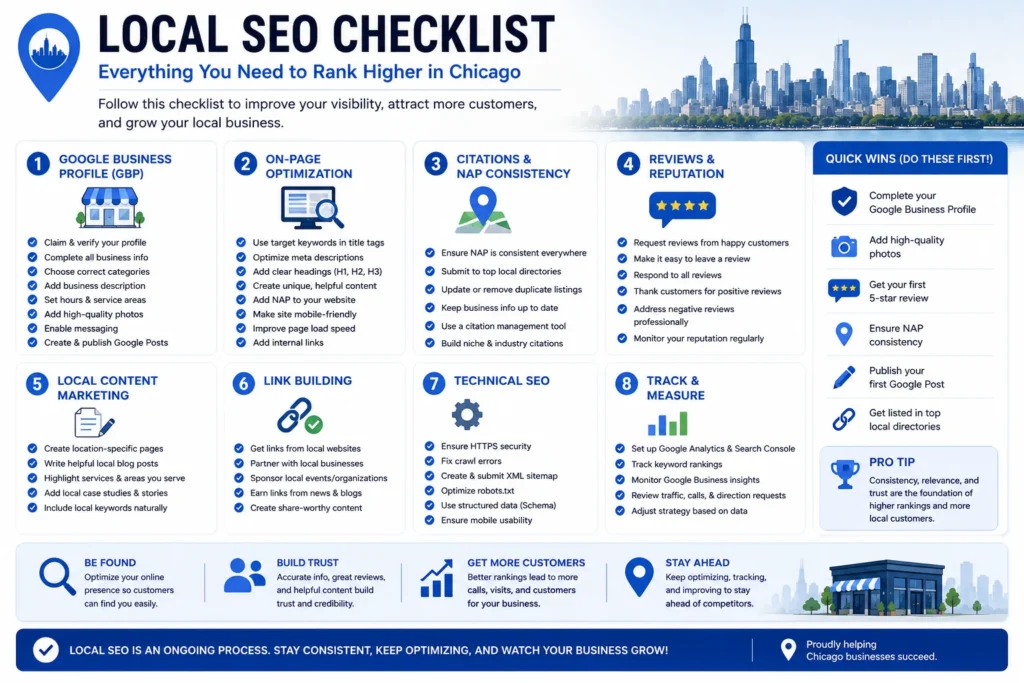
Month 1 Checklist Summary:
□ GBP fully optimized with correct primary category
□ UTM tracking on GBP website link
□ Tier 1 citations clean and consistent
□ Review request system launched
□ Website NAP consistent with GBP
□ LocalBusiness schema implemented
□ Location pages planned
Frequently Asked Questions About Local SEO in Chicago
How long does it take to rank in the Chicago local pack?
For low-to-mid competition categories and neighborhoods, 6–12 weeks of consistent optimization is a reasonable expectation for initial movement. For high-competition categories — attorneys, contractors, medical practices, home services in dense neighborhoods — 6–12 months is more realistic for sustained top-3 local pack presence.
Do I need a Chicago address to rank in Chicago?
For the local pack, yes — Google requires a physical, verified address in or near the area you want to rank in. Service-area businesses can hide their address while still ranking, though proximity to the searcher still influences results. Businesses operating entirely outside Chicago will struggle to rank inside city limits without a verified local presence.
Is local SEO worth it for a brand-new Chicago business?
Yes, but set realistic expectations. A new business needs to build reviews, citations, and content from scratch. The first 90 days are mostly foundation work. The compounding return comes at months 4–9. Starting early is better than waiting until you ‘need’ rankings — by then, competitors have a head start that takes months to close.
What’s the difference between local SEO and Google Ads?
Google Ads (including Local Services Ads) delivers traffic immediately but stops when you stop paying. Local SEO takes longer to build but creates durable rankings that generate leads at no cost per click. Most Chicago small businesses benefit from running both: Ads for immediate pipeline, SEO for long-term compounding return. They serve different parts of the growth timeline.
Should I target ‘Chicago’ or specific neighborhoods?
Both. Optimize your GBP and core website pages for Chicago-wide terms. Build neighborhood-specific location pages and content for the areas you actually serve — this is where most competitors are weakest and where local pack rankings are most achievable.
How many reviews do I need to rank in Chicago?
There is no fixed threshold, but in most competitive Chicago categories, fewer than 50 reviews makes a profile thin by comparison to local pack leaders. In high-competition categories like legal, medical, or home services in central Chicago neighborhoods, the map pack leaders typically have 150–500+ reviews. The goal is to not look like the least-reviewed option in your set of competitors.
Does social media affect local SEO rankings?
Not directly. Social signals are not a confirmed Google ranking factor. However, active social profiles contribute to entity authority (Google confirming your business is real and active), can generate local press mentions and backlinks, and drive traffic that creates behavioral signals. It’s a secondary effect, not a primary one.
What is NAP consistency and why does it matter?
NAP stands for Name, Address, Phone number. NAP consistency means your business information appears identically across all online directories, your website, and your GBP. Google cross-references these sources to verify your business. Inconsistencies — old addresses, name variations, different phone numbers — create ambiguity that can suppress local rankings.
Can I rank in multiple Chicago neighborhoods?
Yes, but the strategy differs by business type. Brick-and-mortar businesses rank primarily in the area around their physical location. Service-area businesses can rank across multiple neighborhoods by defining their service areas in GBP and building neighborhood-specific content pages on their website. Multi-location businesses should have a separate GBP listing for each physical location.
What is a Google Business Profile and why does it matter?
Your Google Business Profile (GBP) is the free listing that appears in Google Search and Google Maps when people search for your business or a related service. It’s the primary vehicle for local pack rankings. A fully optimized GBP — with correct categories, complete information, active photos, and consistent review management — is the highest-leverage single asset in local SEO.
How do I know if my local SEO is working?
Track these metrics monthly: GBP calls, direction requests, and website clicks (from the GBP Insights dashboard); local pack ranking position for your primary keywords (use a tool like BrightLocal or GeoRanker for accurate tracking with location simulation); organic traffic to location pages (Google Search Console); and leads or phone calls attributable to local search (call tracking + UTM parameters).
What is a local content cluster?
A local content cluster is a group of interconnected pages on your website that collectively build topical authority for a service + geography combination. A pillar page covers the main service broadly. Cluster pages go deep on specific questions, comparisons, or neighborhood-level content. Internal links connect them. Together, they signal to Google that your site is a comprehensive resource on this topic for this market.
Does my business need schema markup for local SEO?
Yes. LocalBusiness schema markup (JSON-LD format) gives Google structured data about your business type, location, hours, and contact information. It directly reinforces your GBP data and on-page relevance signals. FAQPage schema on your FAQ sections can earn featured snippet placement and AI Overview citations. Schema won’t single-handedly move rankings, but its absence is a gap your optimized competitors likely don’t have.
What are behavioral signals in local SEO?
Behavioral signals are user interaction metrics that Google interprets as quality and relevance signals. For local SEO, these include: click-through rate on your map pack listing, GBP profile views versus calls placed (engagement rate), direction requests, website visits from your GBP listing, and whether users ‘bounce back’ to the search results after visiting your page. Businesses with stronger behavioral signals tend to rank higher, all else being equal.
What is GBP spam and how does it affect my rankings?
GBP spam refers to competitor listings that violate Google’s guidelines — keyword-stuffed business names, fake addresses, duplicate profiles, or categories that don’t match the actual business. In competitive Chicago categories, spam listings do occupy local pack spots that legitimate businesses should hold. You can report violations through Google’s Business Redressal Complaint Form. Clear-cut violations are often actioned within 2–8 weeks.
How does voice search affect local SEO?
Voice search queries are longer, more conversational, and often question-based (‘What’s the best plumber in Wicker Park that’s open now?’). To capture voice search traffic: build comprehensive FAQ content with direct answers, ensure your GBP has accurate hours (voice search frequently surfaces ‘open now’ results), and include conversational keyword variants in your page copy and GBP description.
Should I respond to negative Google reviews?
Always. Responding to negative reviews signals to Google that you’re actively managing your profile (a positive behavioral signal) and demonstrates to prospective customers that you address problems professionally. Never argue, never name-call, and never offer refunds or compensation publicly. A measured, professional response to a negative review often converts neutral observers into customers more effectively than ten 5-star reviews.
What is the Google Local Services Ads and how is it different from local SEO?
Google Local Services Ads (LSA) are paid placements that appear above the local pack for service-related queries. They include a ‘Google Guaranteed’ or ‘Google Screened’ badge and charge per lead rather than per click. LSAs and local SEO are separate channels — LSAs require ongoing spend, while local SEO builds organic presence. Running both simultaneously creates maximum search visibility during the months before SEO results compound.
How do I track calls from my Google Business Profile?
Use a call tracking number (from a provider like CallRail) as your GBP phone number, separate from your website number. This lets you attribute calls specifically to GBP versus your website or other sources. Combined with UTM parameters on your GBP website link, you’ll have complete visibility into what percentage of your leads come from local search.
What Chicago-specific local link-building opportunities should I pursue?
High-value Chicago-specific link sources include: neighborhood business improvement district (BID) and Special Service Area (SSA) websites, the Chicago Department of Business Affairs and Consumer Protection directory, Crain’s Chicago Business company profiles, Block Club Chicago neighborhood business features, local event sponsorship pages, Chicago SBDC member listings, and university or hospital affiliate directories if applicable to your category.
Ready to Dominate Chicago Local Search?
Local SEO in Chicago rewards businesses that build their foundation correctly and maintain it consistently. The companies showing up in the local pack for your category right now didn’t get there by accident — they invested in the right strategy, executed it methodically, and kept at it.
If you’re ready to do the same, Zolqix Digital specializes in local SEO for Chicago small businesses. We handle everything in this guide — and we show you exactly what we’re doing and why, every month.
Get Your Free Chicago Local SEO Audit
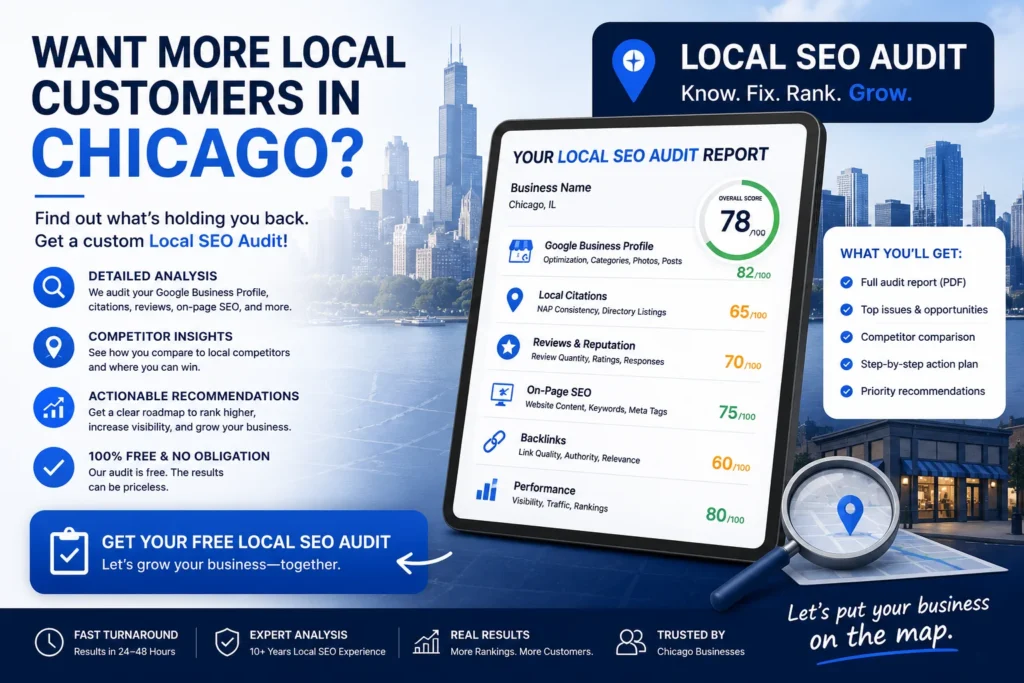
We’ll analyze your Google Business Profile, citation health, local pack rankings, and website — and tell you exactly where you’re losing ground to competitors. No obligation. Delivered within 48 hours.
Request Your Free Audit at zolqix.com
Schedule a Free Strategy Consultation
Talk to a Chicago local SEO specialist about your specific market, your competitors, and what a realistic 90-day roadmap looks like for your business.
Book a Free 30-Minute Consultation at zolqix.com
Questions? Call us directly or email hello@zolqix.com
Every Chicago business we work with starts with an audit. We don’t pitch a package until we understand your market, your competition, and your realistic upside. That’s how we’d want to be treated — so that’s how we operate.
About Zolqix Digital
Zolqix Digital is a Chicago-focused Local SEO agency dedicated to helping small businesses rank higher in Google Search and Google Maps. Our expertise includes Google Business Profile optimization, citation management, local SEO strategy, technical SEO, review management, and content marketing. Using data-driven strategies and proven best practices, we help businesses increase local visibility, attract qualified customers, and achieve sustainable long-term growth.
Written by
zolqix — Zolqix
Digital marketing team running local SEO, Google Ads, and growth campaigns for Chicago-area businesses. We write from what we see in active accounts.
Free — $500 value
Ready to rank
in Chicago?
Get a written audit showing exactly what’s holding back your local rankings. No call. No pitch.
No credit card • Written report within 24 hours • No obligation