
NAP Consistency in Chicago: Why Your Citations Are Hurting Your Rankings
zolqix
Zolqix Team
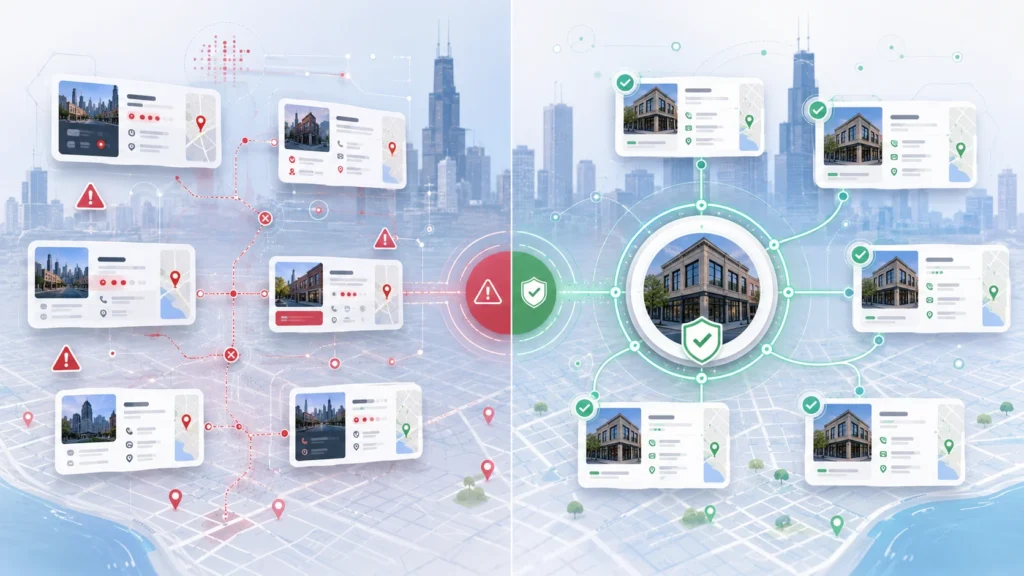
Strong NAP consistency in Chicago helps search engines connect every directory listing with the same business entity — optimizing your Google Business Profile, generating reviews, improving your website — but your local rankings are still underperforming, inconsistent citations may be silently undermining everything else.
NAP consistency — the exact match of your business Name, Address, and Phone number across every directory, listing, and online mention — is one of the most commonly misunderstood local SEO factors. When it’s clean, it operates invisibly in the background, amplifying every other signal you’re building. When it’s broken, it creates what Google’s local algorithm interprets as entity uncertainty — a fundamental trust deficit that suppresses rankings regardless of how well-optimized your GBP is or how many reviews you have.
For Chicago businesses specifically, citation inconsistency is a larger problem than it is in most US markets. Chicago’s density of businesses, its 77 recognized neighborhoods, its history of address changes driven by development cycles, and the sheer volume of directory data flowing through national aggregators about one of the country’s third-largest cities all create more citation noise than a business in a mid-size market would typically face.
This guide covers exactly what NAP consistency is, why it matters for Chicago local rankings, the specific inconsistency types that cause the most damage, the top directories that matter for Chicago businesses, the tools to audit your own citations, and a step-by-step cleanup process.
Quick Answer: What is NAP consistency?
NAP = Name, Address, Phone number.
NAP consistency means your business information appears identically — not approximately, identically — across every place it’s mentioned online: directories, review sites, social profiles, your own website, and your Google Business Profile.
Google cross-references your NAP across the web to verify your business is real and located where you claim. Inconsistencies create trust ambiguity. Trust ambiguity suppresses rankings.
What NAP Consistency Is — And What It Actually Does
NAP stands for Name, Address, and Phone number. NAP consistency is the practice of ensuring your business information appears identically across every online mention — not just on the platforms you manage directly, but across every directory, aggregator, map service, review site, and community resource that mentions your business.
The Two Types of Citations That Carry NAP Data
- Structured citations: formal directory listings where your business information appears in defined fields — Yelp, Apple Maps, Bing Places, the Chicago Chamber of Commerce member directory, industry-specific platforms like Houzz, Avvo, or Healthgrades. These are what most people mean when they talk about citations.
- Unstructured citations: mentions of your business NAP in contexts that don’t use directory-style formatting — a Chicago Tribune business feature that names your address, a Block Club Chicago neighborhood article mentioning your phone number, a community organization website listing local businesses. These carry significant authority signals precisely because they’re editorial rather than self-submitted.
What Citations Actually Do in Google’s Local Algorithm
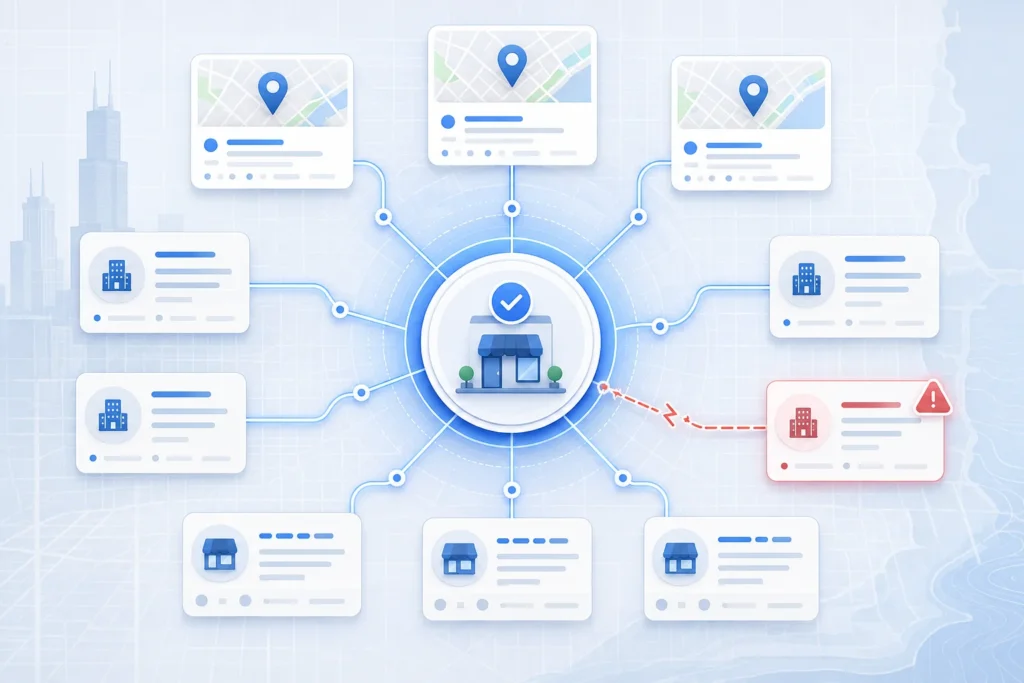
Citations serve three distinct functions in Google’s local ranking system, each important in its own right:
- Entity verification: Google cross-references your NAP across multiple sources to confirm your business is real and located where you claim. The more authoritative sources that agree on your information, the higher Google’s confidence in your business entity — which translates directly into more stable, more prominent local pack rankings.
- Location signal amplification: consistent citations from locally relevant Chicago sources reinforce your geographic relevance for Chicago-specific searches. A Chicago electrician with citations from the Chicago Electrical Contractors Association and the Wicker Park-Bucktown SSA website sends stronger geographic signals than one with the same number of generic national directory listings.
- Prominence contribution: Google’s publicly documented local ranking factors explicitly include online mentions as a component of prominence. Citation volume and source authority both contribute — but in 2026, accuracy matters far more than volume. A Chicago business with 40 clean, accurate citations consistently outperforms one with 200 citations containing NAP inconsistencies.
Citations build entity and location trust, while backlinks strengthen website authority. See how citations and backlinks affect Chicago local SEO before deciding where to invest first.Google also explains how it sources and uses business information across Search and Maps.
The Most Damaging NAP Inconsistencies in Chicago Business Audits
Not all inconsistencies cause equal damage. Some create minor background noise; others fundamentally confuse Google’s entity resolution process. Here are the specific inconsistency types that cause the most ranking suppression — ordered by severity.
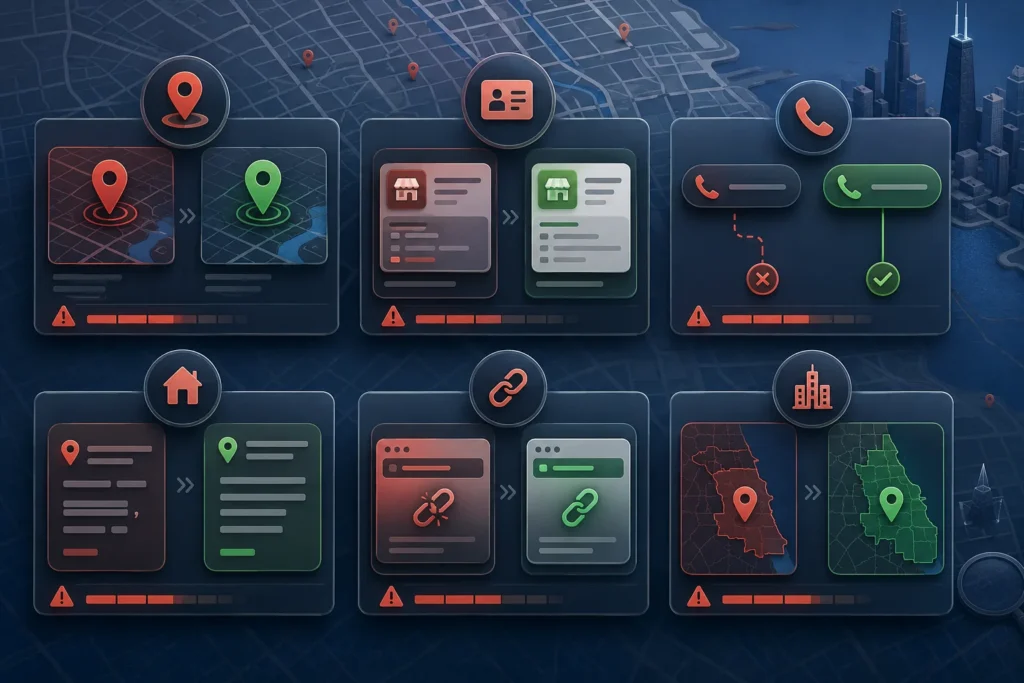
1. Old Address From a Previous Chicago Location
This is the single most damaging NAP inconsistency type, and the most common for established Chicago businesses. Chicago has seen significant commercial real estate churn — businesses that moved from Wicker Park to Logan Square, from the South Loop to River North, from one Lincoln Park address to another during a building renovation. Each move potentially created dozens of directories still listing the old address, sometimes years later.
Google sees two different addresses for the same business entity. This doesn’t just create citation noise — it signals that your business is in a location conflict. Google responds by ranking your listing with less confidence, which manifests as lower local pack positions and more ranking volatility during algorithm updates.
If your Chicago business has moved in the past five years, address cleanup is your highest-priority citation task. Some directories only update when you manually claim and correct the listing — they don’t automatically reflect changes you make to your GBP. And aggregator databases can re-push old address data to directories you’ve already fixed, requiring a second correction pass 3–4 months after the initial cleanup.
2. Chicago Neighborhood vs. City Classification
This is a Chicago-specific inconsistency that doesn’t exist in most markets. Chicago’s 77 recognized neighborhoods have strong local identities — and some directories and aggregators list Chicago businesses by neighborhood rather than by city. A business in Andersonville may appear as ‘Chicago, IL’ on some directories and ‘Andersonville, IL’ or even ‘Edgewater, IL’ on others.
While Google generally understands that these are all within Chicago’s city limits, inconsistent neighborhood vs. city classification creates a citation matching problem for Google’s aggregator-analysis systems. The safest approach: use ‘Chicago, IL’ as your city designation consistently across all directories, and reference your neighborhood in the business description and content rather than in the address field.
3. Business Name Variations
Business name variations are the second-most-common inconsistency type in Chicago audits. What looks like harmless shorthand to a human creates entity ambiguity for Google’s Knowledge Graph:
- ‘Chicago Dental Group’ vs ‘Chicago Dental Group, LLC’ vs ‘CDG Dental’
- ‘Smith’s Plumbing & Heating’ vs ‘Smith Plumbing and Heating’ vs ‘Smiths Plumbing’
- ‘The Corner Bistro Chicago’ vs ‘Corner Bistro Chicago’ vs ‘Corner Bistro’
Google’s Knowledge Graph attempts to resolve whether these are the same entity. When it can’t resolve with confidence, it ranks conservatively — lower positions and less stable rankings that fluctuate more with algorithm updates. Choose one exact business name — the legal name or your most consistently used DBA — and standardize it everywhere, including punctuation and abbreviation format.
4. Phone Number Changes
Chicago businesses that changed their phone number — even once, even years ago — often have old numbers persisting in directories. Some directories are updated only by the aggregators that seeded them, and aggregator databases can take months to reflect changes. The problem compounds when businesses use virtual phone numbers, VOIP numbers that change with service providers, or marketing-specific numbers that have since been discontinued.
Old phone numbers are particularly damaging because they affect both citation consistency signals and actual customer experience. A customer who finds your old number on a directory and calls it to get a disconnected message or an unrelated business has had a negative interaction traceable to your citation profile — a behavioral signal problem layered on top of the ranking signal problem.
5. Suite and Address Format Variations
This is the inconsistency most businesses overlook because it seems minor. In Chicago’s dense office and retail environment — where suite numbers, floor numbers, and building designations are common — formatting variations create genuine citation-matching confusion:
- ‘175 W. Jackson Blvd, Suite 1000’ vs ‘175 West Jackson Boulevard Ste 1000’ vs ‘175 W Jackson Blvd #1000’
- ‘Chicago, IL 60604’ vs ‘Chicago, Illinois 60604’ vs ‘Chicago IL, 60604’
- ‘W. Wacker Dr.’ vs ‘West Wacker Drive’ vs ‘W Wacker Dr’
Google’s citation-matching systems handle some of these variations through normalization — but not reliably for all formats or in all contexts. In Chicago’s highly competitive local pack environment, where businesses with similar GBP quality are separated by fine-margin differences in their prominence signals, …even minor address formatting inconsistencies can be the tiebreaker that costs you a top-three Google Map Pack position.
Standard: match your USPS-standard address exactly as it appears in your Google Business Profile. Use the official USPS ZIP Code Lookup to confirm the standard format for your Chicago address.
6. Website URL Variations
Increasingly, your website URL is treated as part of your NAP — it’s the digital location signal alongside your physical address. URL variations that create citation inconsistency:
- ‘https://www.smithplumbing.com’ vs ‘http://smithplumbing.com’ vs ‘smithplumbing.com’
- Old domain names from a previous website that still appear on some listings
- Trailing slashes, www vs non-www inconsistencies
Use your canonical URL consistently across all directory listings. If you’ve migrated websites or changed domains, the old URL appearing on legacy directory listings is both a citation signal problem and a potential dead link issue.
| Inconsistency Type | Severity | Most Common Cause | Priority to Fix |
| Old address from previous location | Critical | Business moved without systematic citation update | Immediate — fix Tier 1 first |
| Neighborhood vs city classification | High (Chicago-specific) | Aggregators assigning neighborhood as city | Fix on all Tier 1 and Tier 2 platforms |
| Business name variations | High | Informal shorthand, LLC vs DBA, name changes | Standardize canonical name then fix everywhere |
| Old phone number | High | Number changed without directory notification | Update GBP first, then cascade through tiers |
| Suite/address format variations | Medium-High | No standardized format applied at setup | Fix Tier 1 then aggregators; cascade downstream |
| Website URL variations | Medium | Old domain, http vs https, www vs non-www | Fix Tier 1 platforms; canonical tag on website |
How NAP Inconsistency Suppresses Chicago Rankings — The Mechanism
Understanding how Google uses citation data helps explain why inconsistency causes the specific ranking problems it does — and why fixing citations produces results even when nothing else about your SEO changes.
Entity Resolution and the Knowledge Graph
Google’s Knowledge Graph is a database of entities — real-world businesses, people, places, and concepts — and the relationships between them. When Google encounters your business name online, it attempts to resolve whether that mention refers to the same entity it already knows about or a different one.
Clean, consistent NAP signals make entity resolution straightforward: all mentions match, all point to the same address, all list the same phone number. Google resolves the entity with high confidence and ranks accordingly.
Inconsistent NAP signals create resolution uncertainty: are ‘Smith HVAC’ on Yelp and ‘Smith Heating & Cooling LLC’ on Angi the same business? Is the business at ‘1200 N. Michigan Ave’ the same as the one at ‘1200 North Michigan Avenue’? Google hedges by ranking with lower confidence — which manifests as lower positions, higher ranking volatility, and slower response to positive signals like new reviews.
Why Citation Problems Compound
The compounding nature of citation inconsistency is what makes it so damaging in Chicago’s competitive environment. Imagine a Chicago HVAC company with the following:
- A fully optimized GBP with 120 reviews
- Strong on-page SEO with correct title tags and schema
- But: an old address from a 2021 office move still appearing on 35 directories, a name variation (‘Smith HVAC’ vs ‘Smith Heating & Cooling’) across 20 directories, and an old phone number on 15 directories
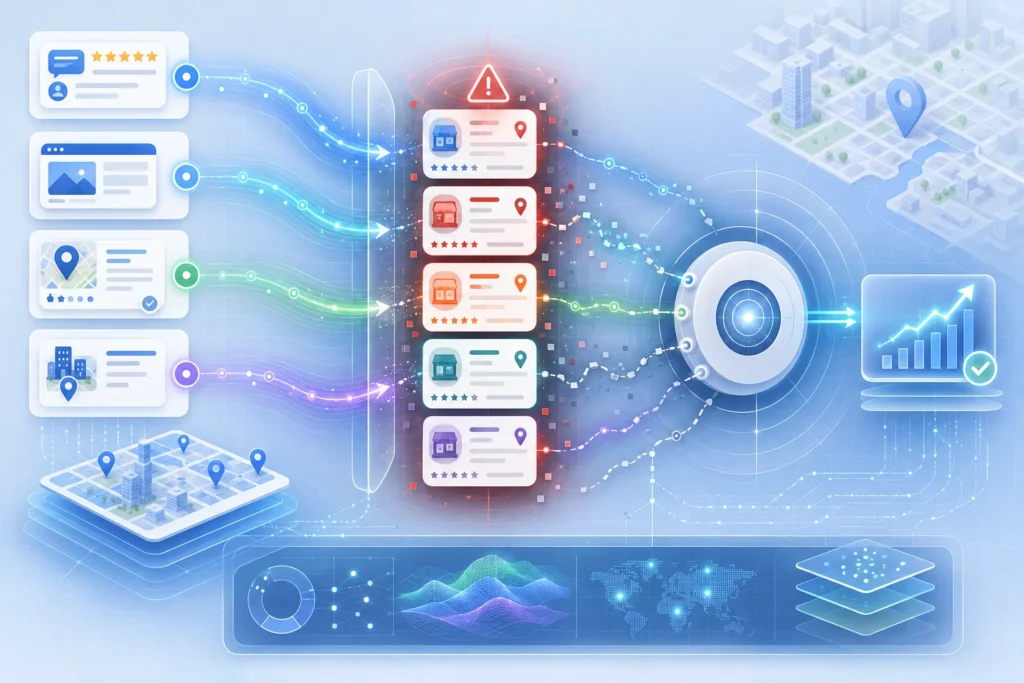
Every new review this business earns, every GBP post it publishes, every piece of content it creates — all of these positive signals are being credited to an entity Google can’t fully resolve with confidence. The reviews help less than they should. The GBP optimization delivers less ranking lift than it would with clean citations. The content builds less authority than it otherwise could.
Fix the citations, and all of those existing positive signals start delivering their full value. This is why citation cleanup often produces ranking improvements even without any other changes to a business’s local SEO — not because citations alone are powerful, but because they were blocking the value of everything else.
The Top Chicago Citation Sources — Tiered by Impact
Not all directories carry equal weight for Chicago local SEO. Here’s the complete prioritized framework for Chicago businesses — organized by the impact of getting them right (and the damage of getting them wrong).
Tier 1 — Critical: Fix These First, No Exceptions
These are the most indexed, most visible, and most influential platforms for any Chicago business. Inconsistencies here cause the most damage. Corrections here produce the fastest improvement. Every Chicago business must have accurate, complete listings on all five before any other citation work.Start with your Google listing because a properly optimized Google Business Profile gives your other citation corrections a reliable central reference.
| Platform | Access | Chicago-Specific Importance | Priority |
| Google Business Profile | business.google.com | Primary local pack signal — everything else feeds into this. Category selection especially critical in Chicago’s dense competitive market. | #1 — The foundation |
| Apple Maps | businessconnect.apple.com | Default map on all iPhone and Siri searches. Chicago’s high iPhone penetration and tech-forward professional demographic make this a major traffic source. | #2 — Fix immediately |
| Bing Places | bingplaces.com | Powers Bing search and Cortana. Chicago’s large professional base (Microsoft Office 365 users) gives Bing meaningful search share in corporate categories. | #3 |
| Yelp | biz.yelp.com | Yelp is stronger in Chicago than most US cities — particularly for restaurants, home services, and professional services. High DA, heavily indexed, significant review influence. | #4 |
| Facebook Business Page | Facebook Page settings | Social trust signal and citation source — NAP must match GBP exactly, character for character. | #5 |
Tier 2 — Aggregators: Fix These to Cascade Downstream
Data aggregators collect business information and distribute it to hundreds of downstream directories. Fixing your NAP at the aggregator level is the single highest-leverage citation move available for a Chicago business — one correction cascades automatically to dozens or hundreds of directories that would otherwise require individual manual fixes.
| Aggregator | What It Powers | How to Update + Timeline |
| Data Axle (InfoUSA) | Hundreds of directories, GPS systems, voice assistants, smart home devices | brightlocal.com Data Axle integration or data-axle.com directly. Cascade timeline: 4–8 weeks. |
| TransUnion Digital Business Profile Formerly Neustar Localeze | Bing Maps, navigation systems, local data partners, enterprise datasets | localeze.com — claim and update. Cascade timeline: 6–12 weeks. |
| Foursquare / Factual | Tens of millions of apps, Snapchat Maps, Uber, enterprise data products, Apple Maps data supplementation | foursquare.com/business — most underestimated aggregator for downstream reach. Update directly. |
Aggregator timing reality: After fixing Data Axle and Neustar Localeze, allow 8–12 weeks before re-auditing downstream directories. Some auto-update from the aggregator feed within weeks; others take longer or require manual correction even after the aggregator is fixed. A second citation audit at week 12 — not week 6 — gives an accurate picture of cascade effectiveness.
Tier 3 — Industry-Specific: High Authority Within Your Category
These directories carry significant authority within specific verticals. A Chicago HVAC company listed correctly on HomeAdvisor and Angi gets both citation value and category-specific relevance signals that generic directories don’t provide.
| Category | Key Industry Directories | Chicago-Specific Note |
| Home Services | Angi, HomeAdvisor, Houzz, Thumbtack, BuildZoom | High purchase intent + strong DA. Chicago’s home services market is one of the most active in the US for these platforms. |
| Legal | Avvo, FindLaw, Justia, Martindale-Hubbell, lawyers.com | Critical for Cook County attorney entity verification. Google trusts these heavily for legal professional searches. |
| Healthcare | Healthgrades, Zocdoc, WebMD, Vitals, US News Health | Patient discovery + entity verification. Insurance directory listings add category-specific citation value. |
| Restaurants & Food | OpenTable, TripAdvisor, Zomato, Yelp (also Tier 1) | Chicago’s dining market is exceptionally active on these platforms. Multiple platforms each drive meaningful traffic independently. |
| Real Estate | Zillow, Realtor.com, Trulia, Homes.com | National aggregators often dominate Chicago real estate local packs; citations here are the primary organic channel. |
| Financial & Insurance | FINRA BrokerCheck, CFP Board, NAPFA, state licensing boards | Trust-critical category — government and professional body citations carry exceptional authority in Illinois. |
| Auto Services | RepairPal, CarGurus Service, AutoMD, YourMechanic | Chicago’s large commuter population makes auto service citations high-traffic sources. |
Tier 4 — Chicago Local: Highest Geographic Relevance
This is where Chicago citation strategy diverges most sharply from generic local SEO advice. These sources carry the most local relevance for Chicago businesses — and out-of-market competitors can’t replicate them because they require genuine Chicago presence and community engagement.
| Chicago Citation Source | Type | Authority | How to Get Listed |
| Chicagoland Chamber Member Directory | Citation + editorial link | Very High | Join as member — directory listing + potential feature articles at chicagochamber.org |
| Illinois Chamber of Commerce | Citation + state directory | High | Statewide membership adds Illinois-level entity signal at ilchamber.org |
| Chicago SBDC | Government-adjacent citation | High | Register as client — free listing with strong trust signal |
| SCORE Chicago Chapter | Nonprofit directory citation | High | Register with local chapter — free listing at score.org |
| BBB Chicago and Northern Illinois | Citation + trust signal | High | Claim free listing; BBB accreditation adds enhanced signals at chicago.bbb.org |
| Chicago Tribune business directories | Unstructured press citation | Very High | PR outreach for features, roundups, or neighborhood business coverage |
| Crain’s Chicago Business | Unstructured editorial citation | Extremely High | PR outreach to reporters covering your industry category at chicagobusiness.com |
| Block Club Chicago | Neighborhood press citation | High | Pitch hyperlocal neighborhood stories at blockclubchicago.org |
| Neighborhood BID / SSA websites | Hyper-local citation | High | Each of Chicago’s 77 neighborhoods has Business Improvement Districts and Special Service Areas with member directories |
Illinois Secretary of State Business Search | Government citation | High | Automatic if incorporated in Illinois — verify your listed address is current |
| City of Chicago Business License Search | Government citation | High | Automatic if you hold a Chicago business license — verify accuracy |
| Illinois DCEO business directories | Government citation | High | Illinois Department of Commerce business resource directories |
| Chicago Public Library business resources | Community citation | Medium | Some CPL branches maintain local business resource directories |
The Tier 4 competitive advantage in Chicago: National SEO guides list generic citation sources any US business can access. Chicago’s Tier 4 sources — neighborhood SSA websites, Block Club Chicago mentions, Crain’s Chicago Business features, City of Chicago business license database — require genuine Chicago presence and community engagement. A business in Phoenix can’t get a Lincoln Square Business Alliance citation. This is precisely why these sources carry more local authority than generic directories: they’re verifiable proof of Chicago-specific presence.These local citations work alongside other Chicago local SEO ranking factors that influence map visibility, relevance, and prominence.

Citation Audit Tools: How to Find Every Inconsistency
Manual citation auditing — searching your business name across directories one by one — is incomplete, tedious, and misses the aggregator-level sources where inconsistencies typically originate. The right tools surface problems you’d never find manually and prioritize what to fix first.
Free Tools
- Google Search: Search your business name in quotes, your old phone number in quotes, and your old address in quotes separately. The results show which directories are indexing outdated information. Not comprehensive but surfaces the most-indexed mentions quickly.
- Moz Local free scan (moz.com/local): Enter your business name and ZIP code for a snapshot of your listing presence and consistency score across major directories. Fast, free, and directionally useful as a starting assessment.
- BrightLocal Citation Tracker can identify incorrect NAP information, duplicate listings, and missing citation opportunities. The free trial includes a full citation report showing every directory mention, NAP accuracy score, and specific inconsistencies flagged. Run this before deciding on any paid tool.
- Whitespark Citation Finder (limited free, whitespark.ca): Finds citation opportunities and existing citations. Free version covers major directories; paid covers the full list. Strongest for identifying Chicago-specific local directories you’re not yet listed on.
Paid Tools Worth Investing In
- BrightLocal Citation Tracker ($39–$49/month): The industry standard for ongoing citation monitoring. Tracks new citations, flags new inconsistencies, monitors competitor citation profiles, and provides before/after consistency scoring. Essential for any sustained local SEO campaign for a Chicago business.
- Whitespark Local Citation Finder ($33–$83/month): Strongest for finding new citation opportunities in specific local markets — particularly useful for identifying Chicago-specific local directories and neighborhood organization sources that competitors have but you don’t.
- Semrush Listing Management ($20–$40/month add-on): Manages NAP across a defined network of directories from a single dashboard. Good for businesses that want streamlined management but not as comprehensive as BrightLocal for audit depth.
- Yext ($199–$449+/month): Manages your NAP across a large network of directories simultaneously. Fast and comprehensive, but creates dependency — when you stop paying, some directories may revert to pre-Yext data. Best for multi-location Chicago businesses or franchises where management overhead justifies the cost.
| Tool | Cost | Best For | Chicago Coverage | Audit Depth |
| BrightLocal | Free trial / $39+/mo | Ongoing monitoring + cleanup | Strong — includes local IL directories | Comprehensive |
| Whitespark | Free limited / $33+/mo | Finding new citation gaps | Good — surfaces Chicago-specific sources | Very Deep |
| Moz Local | Free scan / $14+/mo | Quick snapshot assessment | Moderate — major directories only | Good |
| Semrush Listing Mgmt | $20–$40/mo add-on | Streamlined management | Good within partner network | Moderate |
| Yext | $199+/mo | Multi-location management | Strong — wide network | Comprehensive |
| Manual + Google Search | Free | Preliminary spot-check | Variable — depends on effort | Partial |
Before paying for recurring citation software, compare the tool expense with the wider cost of local SEO in Chicago and the time required for manual cleanup.
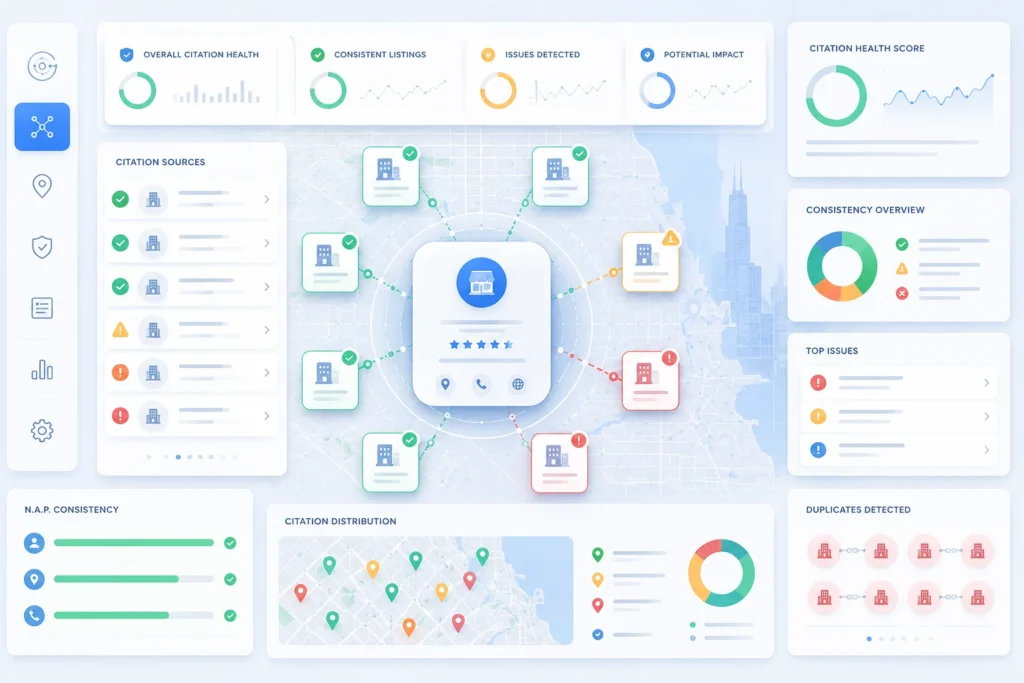
Step-by-Step Citation Cleanup Process for Chicago Businesses
Here’s the exact cleanup sequence that produces the most reliable results for Chicago businesses. Order matters — skipping steps or working out of sequence reduces effectiveness and wastes time.
Step 1: Establish Your Canonical NAP
Before fixing anything, decide what the correct version of your NAP is. This becomes your single source of truth — the exact format you use everywhere, without exception.
- Write your exact legal business name or DBA as you want it to appear everywhere
- Look up your USPS-standard address at usps.com/zip4 — use the exact format returned, including abbreviation style for street types and directionals
- Choose one primary phone number — ideally a local Chicago area code (312, 773, 872) rather than a toll-free number
- Verify this NAP exactly matches what’s on your Google Business Profile
- Document it — create a ‘canonical NAP reference sheet’ that every team member and vendor can access
Your canonical NAP template (example):
Business Name: Smith HVAC Services LLC
Address: 2400 N. Clybourn Ave, Suite 300, Chicago, IL 60614
Phone: (773) 555-0100
Website: https://www.smithhvac.com
Use this exact format — character for character — on every directory. Not ‘N Clybourn,’ not ‘North Clybourn Avenue,’ not ‘Suite #300.’ Exactly this.
Step 2: Run Your Citation Audit
- Set up a BrightLocal free trial and run a full citation audit for your business
- Export results to a spreadsheet
- Flag every listing where Name, Address, Phone, or Website doesn’t exactly match your canonical NAP
- Note the specific correction needed in a separate column
- Sort by tier: Tier 1 first, Tier 2 aggregators second, Tier 3 industry, Tier 4 Chicago local
Step 3: Fix Tier 1 Platforms Manually
Do not use automated tools for Tier 1 platforms — log in directly and fix them to ensure accuracy.
- Google Business Profile: Login at business.google.com. Verify every field matches your canonical NAP exactly — business name (no keyword additions), address format, phone number, website URL with UTM parameters
- Use Apple Business to claim your location and manage how your business appears across Apple services. businessconnect.apple.com. Claim if unclaimed. Update all fields. Apple Maps has a verification process that may take 1–2 weeks to complete.
- Bing Places: bingplaces.com. Import from Google or enter manually. Verify address format matches GBP exactly.
- Yelp: biz.yelp.com. Claim if unclaimed. Update name (watch for keyword additions that violate Yelp’s guidelines), address, phone, website, and business category.
- Facebook Business Page: Update contact information in Page settings. NAP must match GBP exactly — Facebook is particularly prone to old address data persisting.
Step 4: Update Tier 2 Aggregators
- Data Axle: Submit a correction through BrightLocal’s Data Axle integration or directly at data-axle.com. Allow 4–8 weeks for cascade updates to begin appearing in downstream directories.
- Neustar Localeze: Claim and update at localeze.com. Cascade timeline: 6–12 weeks for most downstream directories.
- Foursquare: Claim at foursquare.com/business. Update all NAP fields. Foursquare’s data reaches more downstream apps than most businesses realize — prioritize it even though it gets less direct attention than Yelp or Google.
After fixing aggregators, do not re-audit downstream directories for at least 8 weeks. Checking too early produces misleading results — most downstream directories haven’t had time to update from the corrected aggregator feed. A second audit at week 10–12 gives an accurate picture of cascade effectiveness.
Step 5: Fix Tier 3 Industry Directories
Work through your industry-specific directories in priority order based on domain authority and traffic relevance to your category. For each:
- Search your business name on the directory to find your existing listing
- If unclaimed, claim it through the directory’s business owner process
- Update all NAP fields to match your canonical NAP exactly
- Complete additional profile fields (hours, description, photos, categories) while you have access — partial completion misses citation value
- Document the listing URL and login credentials in your canonical NAP reference sheet
Step 6: Build Chicago-Specific Tier 4 Citations
After cleanup, build new citations from Tier 4 Chicago and Illinois local sources where you’re not yet listed:
- Chicago Chamber of Commerce — chicagochamber.org
- Illinois Chamber of Commerce — ilchamber.org
- BBB Chicago and Northern Illinois — chicago.bbb.org
- SCORE Chicago — score.org (Chicago chapter)
- Illinois SBDC — ilsbdc.com
- Your specific neighborhood BID or SSA — search ‘[your neighborhood] business improvement district Chicago’
- Cook County business licensing database — automatic if licensed
- Illinois Secretary of State business database — automatic if incorporated
- IDFPR license lookup — automatic for licensed professionals
Step 7: Monitor Ongoing
Citation cleanup is not a one-time project. New incorrect citations get created automatically — when aggregators push old information, when directories create auto-generated listings from public data, when someone edits your GBP incorrectly. Set up monitoring as part of your ongoing local SEO maintenance.
- Set up BrightLocal Citation Tracker to monitor your citation profile monthly
- Enable Google Business Profile edit notifications so you’re alerted when anyone suggests a change to your listing
- Re-audit aggregators every 6 months to catch any data reversion
- Add citation monitoring to your monthly local SEO review checklist
Citation Cleanup Completion Checklist:
Canonical NAP documented and distributed to all team members
GBP verified — NAP exact match confirmed
Apple Maps, Bing Places, Yelp, Facebook corrected
Data Axle, Neustar Localeze, Foursquare updated
Top 3 industry-specific directories corrected
Chicago Chamber listing claimed or verified
BBB Chicago listing claimed or corrected
Neighborhood BID/SSA listing claimed (if applicable)
Illinois Secretary of State and IDFPR listings verified (if applicable)
BrightLocal monitoring set up
GBP edit notifications enabled
Re-audit scheduled for week 10–12 post-aggregator updates
Next full audit scheduled for 6 months out
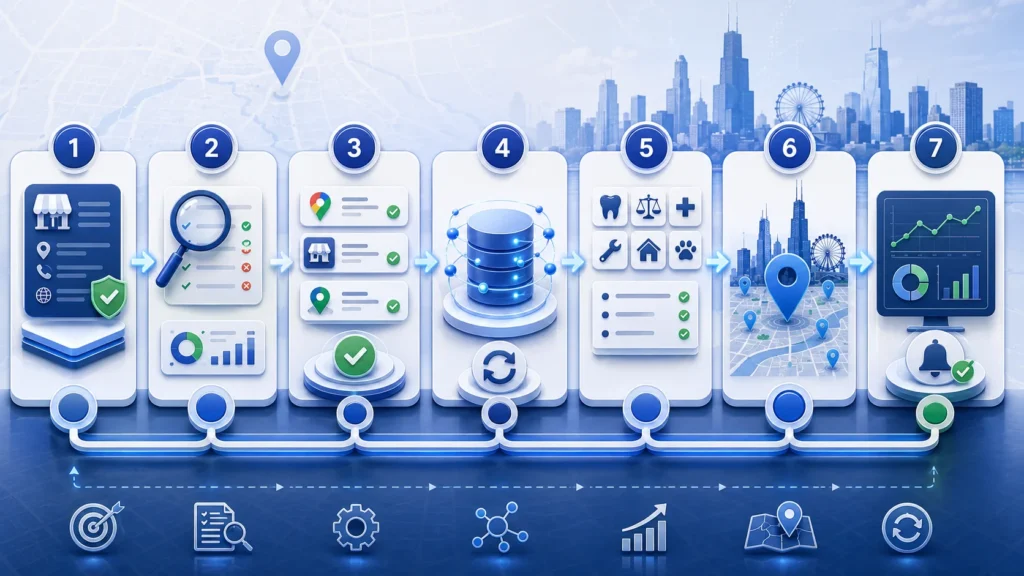
How Long Does Citation Cleanup Take to Affect Chicago Rankings?
Citation cleanup is not the fastest-moving local SEO tactic — but it is one of the most durable. Here’s a realistic timeline for a Chicago business working through the process:
| Timeframe | What’s Happening | What to Watch |
| Week 1–2 | Tier 1 platforms corrected. GBP and major directories now consistent. | GBP Insights — any changes in profile views or call clicks as Google re-processes entity |
| Week 3–6 | Google recrawls corrected listings and begins updating entity confidence. | Google Search Console — check for impressions trends on target keywords |
| Week 6–12 | Aggregator cascade underway. Downstream directories beginning to update. | BrightLocal consistency score — should be improving from initial baseline |
| Month 3–4 | Most major inconsistencies resolved. Citation trust signals strengthening. | Local pack position for primary Chicago keywords — check weekly via BrightLocal or Local Falcon |
| Month 4–6 | Full benefit of cleanup reflected in rankings. Stable, consistent entity signals supporting all other SEO work. | Organic ranking stability — less week-to-week fluctuation is a positive signal |
One pattern that appears reliably in Chicago citation cleanup campaigns: businesses that fix Tier 1 citations and aggregators, then simultaneously maintain GBP activity and review generation, see faster and larger ranking movement than those who do citation cleanup in isolation. Citation cleanup amplifies the other signals — it doesn’t replace them.
Chicago-Specific Citation Considerations
Chicago has several characteristics that affect citation strategy in ways that generic guides miss.
The 77 Neighborhoods Problem
Chicago’s 77 officially recognized neighborhoods create a citation complexity that doesn’t exist in most US cities. Some directories and aggregators use neighborhood names as the city field — listing ‘Wicker Park’ or ‘Andersonville’ or ‘Pilsen’ as the city rather than ‘Chicago.’ While Google generally resolves these as Chicago locations, the inconsistency between ‘Chicago’ in most directories and ‘Wicker Park’ in some directories creates citation-matching noise.
The standard: always use ‘Chicago, IL’ as your city designation in directory listings, regardless of how you describe your neighborhood in marketing materials. Reference the neighborhood in your business description, your GBP posts, and your website — not in the city field of your address.
Chicago Address Complexity
Chicago’s address system — with directional designations (N., S., E., W.) on street names, a systematic grid address system, and many addresses near neighborhood boundaries — creates formatting variation challenges. ‘N. Clark St.’ vs ‘North Clark Street’ vs ‘N Clark St’ are all technically correct but create citation inconsistency when mixed across directories.
Additionally, Chicago’s numbered street grid (addresses in the Loop area have different numbering than the North Side or South Side) can create confusion when businesses near neighborhood boundaries appear in aggregators. A business at 7200 N. Clark St. is in Rogers Park; the same number without the ‘N.’ designation in an aggregator database could be misinterpreted.
The Cook County Government Citation Layer
Cook County maintains multiple government databases that function as authoritative citations: the Cook County Assessor’s property records, the Cook County Recorder of Deeds, and various Cook County business licensing systems. These are automatically generated for businesses with physical addresses in Cook County, and they carry high authority because of their government-domain status.
The issue: these records update slowly and may retain old information long after a business has moved or changed contact details. A Cook County Assessor record listing an old address for a business creates a government-authority inconsistency that can persist and confuse Google’s entity resolution. Checking these records — even though you can’t directly edit them — identifies inconsistencies you can counter with strong, consistent Tier 1–3 citations.
O’Hare and Midway Airport Proximity Complications
Businesses near O’Hare (northwest side of Chicago, Rosemont border) and near Midway (southwest side) sometimes get auto-assigned to Rosemont or Oak Lawn respectively in aggregator databases. This is the same border-proximity misclassification issue that affects suburban Chicago businesses — a Chicago business listed as Rosemont or Oak Lawn in some directories loses Chicago local pack eligibility for those listings. Audit specifically for city name accuracy if your business is within 2 miles of either airport.
Frequently Asked Questions
What is NAP consistency and why does it matter for Chicago local SEO?
NAP stands for Name, Address, and Phone number. NAP consistency means your business information appears identically across every directory, listing, and online mention. Google cross-references NAP data from across the web to verify your business is real and located where you claim — a process called entity resolution. When your NAP is consistent, Google resolves your business entity with high confidence and ranks your listing prominently. When your NAP is inconsistent across sources, Google’s confidence decreases and rankings are suppressed. For Chicago businesses competing in a dense, high-competition market, NAP inconsistency is particularly damaging because the rankings gap between businesses with clean citations and those with messy ones is visible in the local pack results.
How many citations does a Chicago business need?
Quality and accuracy matter far more than count. For most Chicago service businesses, a complete presence across Tier 1 (5 platforms), Tier 2 aggregators (3 platforms), 5–10 relevant Tier 3 industry directories, and 5–10 Tier 4 Chicago-local sources produces a citation profile that supports strong local pack performance. That’s roughly 25–35 high-quality citations rather than hundreds of low-quality ones. In Chicago’s highly competitive categories — legal, medical, home services — expanding to 40–60 quality citations, including multiple Tier 4 Chicago-specific sources, becomes more important as competitors have similar Tier 1–3 profiles and the Tier 4 differentiation matters more.
What are the most important citation sources for Chicago businesses?
In priority order: Tier 1 universals (Google Business Profile, Apple Maps, Bing Places, Yelp, Facebook) — the non-negotiable foundation that must be accurate before anything else. Tier 2 aggregators (Data Axle, Neustar Localeze, Foursquare) — fix these to cascade corrections to hundreds of downstream directories. Tier 3 industry-specific (Houzz, Healthgrades, Avvo, Angi, OpenTable, depending on category). Tier 4 Chicago-local (Chicago Chamber of Commerce, neighborhood BID and SSA websites, BBB Chicago, Illinois Secretary of State registry, City of Chicago business license database, Block Club Chicago mentions, Crain’s Chicago Business features). Tier 4 sources are where genuine Chicago local authority lives — these are the citations out-of-market competitors can’t replicate.
How long does citation cleanup take to affect Chicago rankings?
Tier 1 platform corrections produce initial ranking movement within 4–8 weeks — these platforms are crawled frequently and Google processes entity updates relatively quickly. Aggregator corrections take 8–12 weeks to cascade to downstream directories. Full citation cleanup benefit — where all major inconsistencies are resolved and Google has re-processed its entity confidence — takes 3–5 months to fully reflect in rankings. For Chicago businesses in high-competition categories, citation cleanup often produces measurable ranking improvement without any other SEO changes, because clean citations enable existing positive signals (reviews, GBP optimization, website authority) to deliver their full ranking value — previously blocked by entity uncertainty.
Can citations actually hurt my Chicago local rankings?
Yes — incorrect or conflicting citations actively suppress rankings rather than merely failing to help. The most damaging scenarios: old addresses from a previous Chicago location persisting on dozens of directories (creates location ambiguity); business name variations across sources (creates entity resolution uncertainty); duplicate GBP listings (splits signals); neighborhood-as-city classification (places your business in a different geographic entity); and city-name errors for businesses near Chicago’s borders with Rosemont, Oak Lawn, or suburban municipalities. These suppress rankings gradually rather than dramatically — which is why many businesses don’t connect their citation problems to their ranking plateau until an audit reveals the pattern.
Should I use Yext for my Chicago business?
Yext is a powerful management tool but comes with an important caveat: it works through a ‘data lock’ approach — while you’re subscribed, your NAP is pushed to Yext’s partner network. When you cancel, some directories may revert to their pre-Yext data. For most Chicago single-location small businesses, a one-time manual cleanup plus ongoing BrightLocal monitoring provides better long-term value at lower cost. Yext makes more sense for multi-location Chicago businesses or franchises where managing dozens of locations simultaneously justifies the higher monthly cost and the dependency risk is mitigated by institutional continuity.
How do I prevent new citation inconsistencies from being created?
Set up BrightLocal Citation Tracker or a similar monitoring tool to alert you to new citations and inconsistencies. Enable GBP edit notifications so you’re alerted when anyone suggests a change to your Google Business Profile — this is particularly important in Chicago, where GBP spam and unauthorized edits are more common in competitive categories. Update aggregators first whenever your NAP changes — they’re the source that feeds most downstream directories. Conduct a full citation audit every 6 months rather than treating cleanup as a one-time project. Create and distribute a canonical NAP reference sheet so every team member and vendor uses the correct format consistently.
What is the difference between a citation and a backlink for Chicago local SEO?
A citation is any online mention of your business NAP — it doesn’t require a link to your website. A backlink is a clickable hyperlink from another website to yours. Both are local SEO signals, but they work through different mechanisms: citations build entity trust and location signals; backlinks build domain authority and prominence. The best directory listings provide both — they list your NAP and include a link to your website. For a new Chicago business, citation cleanup and building should come before aggressive link building — because backlinks built on a foundation of inconsistent citations underperform, since Google’s entity confidence is lower for the business the links are pointing to.
Start With What You Can Control Today
NAP consistency is the foundation every other local SEO tactic builds on. Clean citations don’t guarantee top rankings on their own — but inconsistent citations suppress every other positive signal you’re building, from reviews to GBP optimization to website authority. Fix the foundation first.
- This week: audit your GBP, Yelp, Apple Maps, Bing, and Facebook listings against a documented canonical NAP. Fix any inconsistencies you find. This costs nothing and begins improving entity signals immediately.
- This month: run a BrightLocal or Moz Local audit to surface every directory inconsistency. Fix Tier 1 platforms manually. Submit corrections to Tier 2 aggregators.
- Next 90 days: build missing Tier 4 Chicago-specific citations — Chamber, BBB, neighborhood BID. Set up ongoing monitoring. Schedule a follow-up audit at month 3.
Get Your Free Chicago Citation Audit — Delivered in 48 Hours
We’ll audit your full citation profile — NAP consistency score, inconsistencies flagged by directory, Chicago Tier 4 citation gaps, and a prioritized cleanup roadmap specific to your business and neighborhood. Not a generic tool scan. A real assessment of your Chicago market situation.
Request Your Free Audit at zolqix.com
Talk Through Your Citation Situation With a Chicago Local SEO Specialist
A 30-minute call to review your current citation health, identify which inconsistencies are causing the most damage, and map out a cleanup sequence that produces ranking improvement on the fastest realistic timeline.
Book Your Free 30-Minute Call at zolqix.com
Questions? Contact us at hello@zolqix.com or visit zolqix.com
About This Guide
Author: Zolqix Digital Local SEO Team — Chicago-based local SEO practitioners with direct experience auditing and rebuilding citation profiles for Chicago businesses across all 77 neighborhoods and surrounding Cook County communities.
Experience Statement: The citation tier framework, Chicago-specific inconsistency types, and cleanup timeline estimates in this guide reflect direct citation audit work for Chicago businesses in home services, legal, healthcare, restaurant, retail, and professional service categories. Chicago-specific observations about neighborhood classification, Cook County government citation layers, and aggregator city-name misclassification are based on patterns identified across multiple Chicago market citation audits.
Published by Zolqix Digital — Chicago Local SEO Agency | zolqix.com
Written by
zolqix — Zolqix
Digital marketing team running local SEO, Google Ads, and growth campaigns for Chicago-area businesses. We write from what we see in active accounts.
Free — $500 value
Ready to rank
in Chicago?
Get a written audit showing exactly what’s holding back your local rankings. No call. No pitch.
No credit card • Written report within 24 hours • No obligation