
Google Map Pack Chicago: How to Rank in the Top 3 (2026 Guide)
zolqix
Zolqix Team
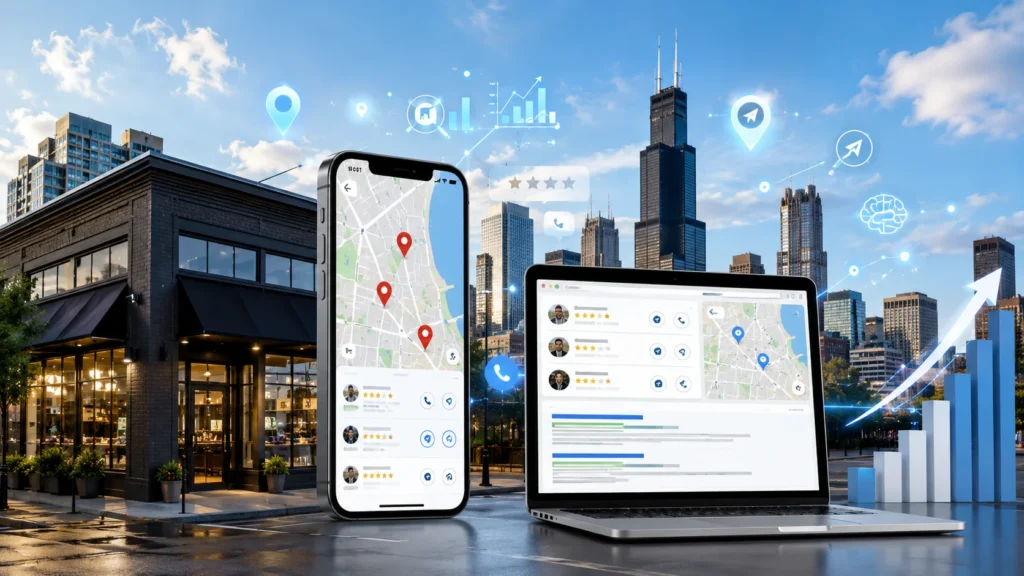
The Google Map Pack — the block of three businesses that appears with a map at the top of local search results — is the most competitive piece of real estate in Chicago local search. Three spots. Thousands of businesses competing for them. And unlike paid ads, you can’t simply outbid your way in.
Understanding how the google map pack chicago works is the first step to showing up in it. Based on our experience optimizing Google Business Profiles across hundreds of Chicago businesses — from solo contractors in Pilsen to multi-location healthcare practices in the Loop — the businesses that consistently hold top-3 positions aren’t necessarily the best-reviewed or longest-established. They’re the ones that built their local SEO infrastructure correctly and never let it slip.
This guide explains what the 3-pack is, how Google decides who ranks in it, why Chicago makes it harder than most markets, the advanced tactics that separate top-3 businesses from the rest, and a step-by-step action plan for breaking in.
What Is the Google Map Pack?
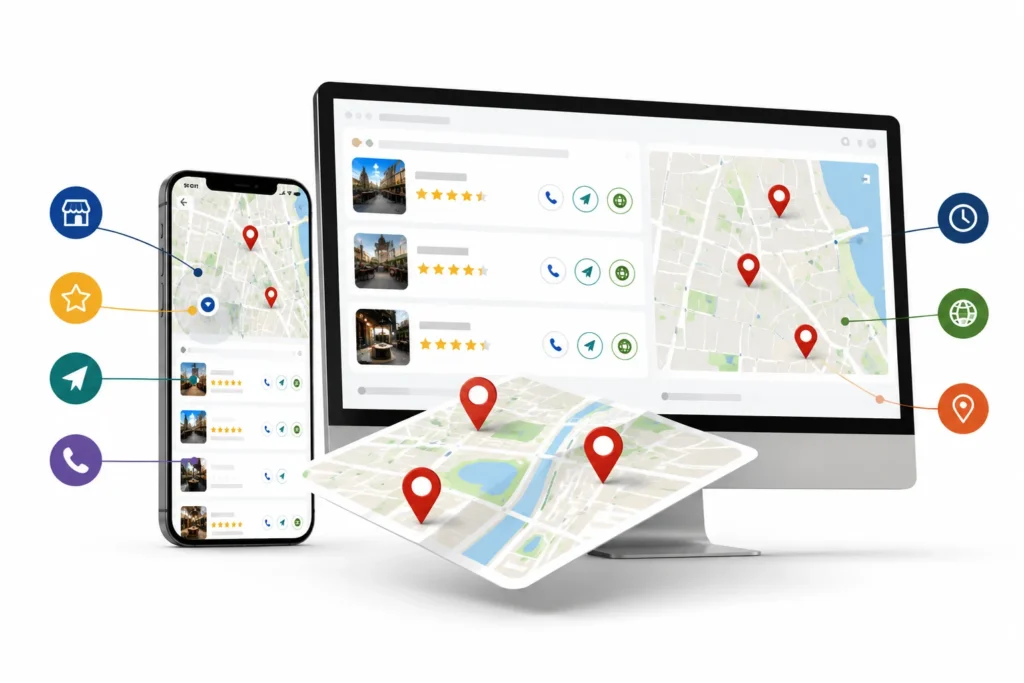
The Google Map Pack (also called the local pack or 3-pack) is a search result feature that displays three local businesses above organic web results for searches with local intent. It includes a Google Maps panel showing each business’s location, plus a listing card for each business showing the name, star rating, review count, address, phone number, and hours.
It appears for queries like:
- ‘plumber near me’
- ‘best accountant Chicago’
- ’emergency HVAC Lincoln Park’
- ‘dentist open now Wicker Park’
- ‘personal injury lawyer Chicago Loop’
The map pack consistently captures 35–45% of all clicks on local search results pages — more than any other element, including paid ads. For a Chicago small business, appearing in the 3-pack for even two or three relevant search terms can account for the majority of inbound calls and leads.
Below the map pack sit the local organic results — traditional web listings. These matter too, and a well-rounded local SEO strategy targets both. But the map pack is where the highest-intent searchers click first, which is why it’s the primary focus for most Chicago businesses investing in local search.
The Three Factors That Rank the Google Map Pack Chicago
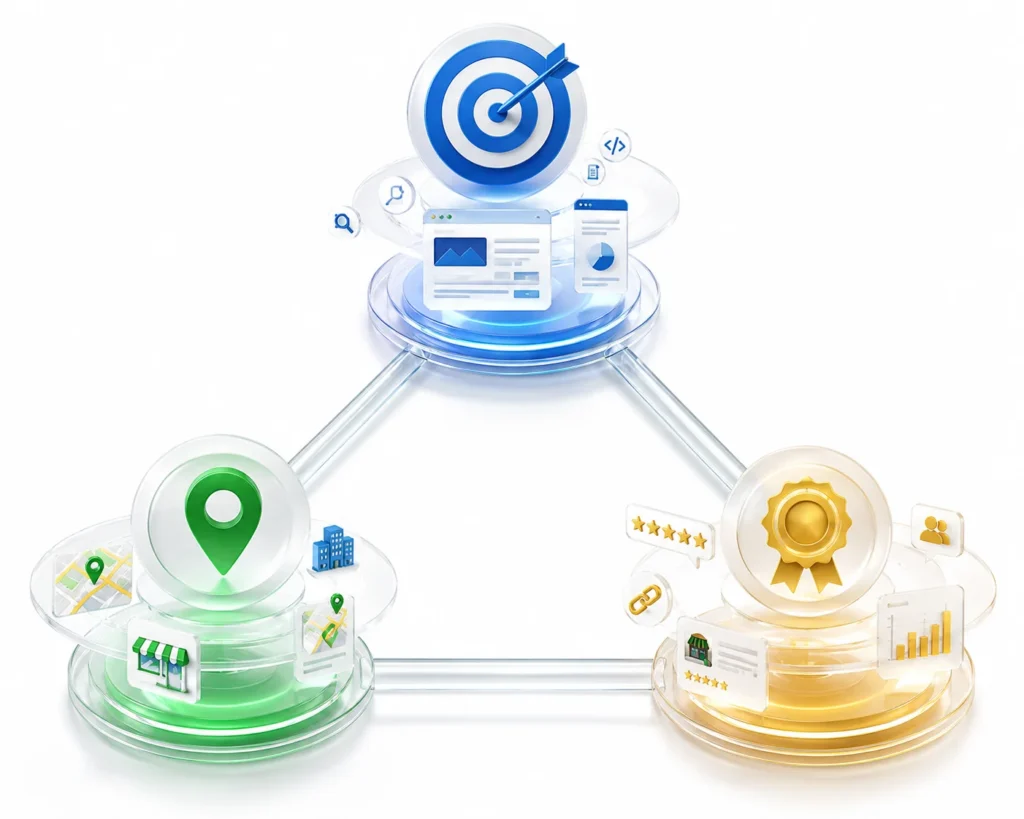
Google’s local ranking algorithm evaluates every business on three dimensions. These are publicly documented by Google and haven’t changed conceptually — but how they’re weighted, and what signals feed into each, has evolved considerably in 2025–2026.
Relevance
Relevance measures how well your business matches what the searcher is looking for. Google assesses it through:
- GBP primary category: The single most important relevance signal. It determines which search queries your listing is eligible to rank for. One common issue we repeatedly find in Chicago audits: businesses using the broadest available category — ‘Contractor,’ ‘Cleaning Service,’ ‘Lawyer’ — instead of the most specific accurate one. A tile installer listed as ‘General Contractor’ becomes invisible to tile-specific searches. This single correction has moved local pack positions for clients within 3–4 weeks.
- Secondary categories: Supporting categories that broaden your eligibility without diluting your primary relevance signal.
- Services listed on your GBP: The more granular and specific, the better. List individual services, not just broad categories.
- Keywords in your GBP description, posts, and review responses: These are indexed by Google and contribute to relevance scoring.
- Your website content: Google reads your site and incorporates it into its assessment of your GBP’s relevance. A thin website with one service page weakens your map pack relevance, regardless of how well your GBP is optimized.
Proximity
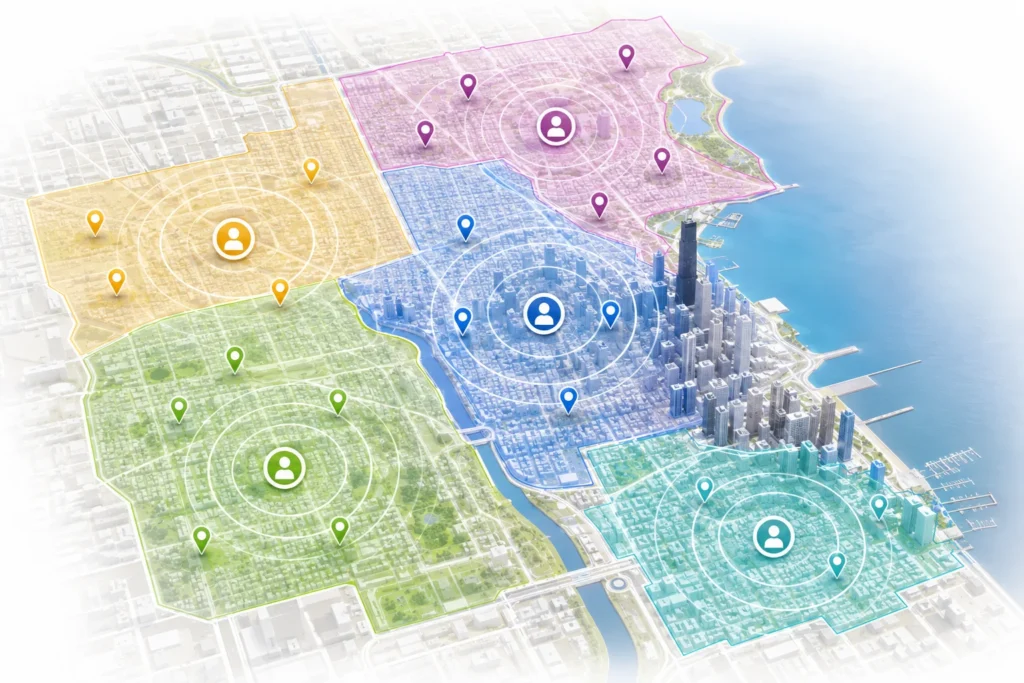
Proximity measures how physically close your business is to the person searching — or to the location specified in the query. It’s the factor you have the least direct control over.
In Chicago, proximity creates a result that surprises many business owners: the same search for ’emergency plumber’ run from River North and from Bridgeport returns almost entirely different map packs. Google’s local results are heavily personalized by searcher location, especially on mobile where GPS data is precise.
What this means practically:
- A business in the Loop doesn’t automatically rank well for searches happening in Logan Square
- Proximity weight in dense urban Chicago means businesses within blocks of each other compete on relevance and prominence — not distance
- Service-area businesses (those without a customer-facing address) can still rank by defining service areas precisely in GBP settings
- Ranking across multiple Chicago neighborhoods requires dedicated neighborhood content and review signals — not just a single GBP listing
Proximity bias: In high-density Chicago neighborhoods where multiple businesses in the same category are within walking distance of each other, proximity becomes less decisive. Google compensates by weighting relevance and prominence more heavily — which means businesses in dense areas compete more on optimization quality than on location.
Prominence
Prominence measures how well-known and trusted your business is across the web. It’s the factor you have the most control over, and it’s where the majority of local SEO effort is directed.
Prominence signals include:
- Google reviews: Count, recency, average rating, content richness, and response rate
- Local citations: Consistent mention of your business NAP across directories
- Backlinks: Especially from locally relevant Chicago sources
- Website authority: Domain strength and on-page optimization depth
- Behavioral signals: Click-through rate, calls, direction requests, time on site
- Entity authority: How well-defined your business is in Google’s Knowledge Graph
In a dense market like Chicago, prominence is often the tiebreaker. Two businesses with similar relevance and proximity will be separated by which one has stronger review signals, a cleaner citation profile, and more user engagement on their GBP listing.
Why Chicago Makes the Map Pack Harder to Crack

Most mid-size US cities have moderate local pack competition. Chicago is not a mid-size city. Several specific factors make it consistently more competitive than most US markets:
Business Density
In categories like personal injury law, HVAC, dental, real estate, and home services, Chicago has dozens — sometimes hundreds — of optimized listings competing for three map pack spots within any given neighborhood radius. Businesses we audit that are struggling to break into the top 3 are almost never failing due to a single obvious error. They’re losing across multiple signals to competitors who are doing everything slightly better.
Neighborhood Search Behavior
Chicagoans search by neighborhood. ‘Electrician Andersonville,’ ‘chiropractor Wicker Park,’ ‘dog groomer Logan Square’ all return distinct local packs, each with its own competitive landscape. A business that optimizes only for ‘Chicago’ is invisible to searchers who add neighborhood qualifiers — which in Chicago is a significant portion of local search behavior.
We’ve observed that Chicago businesses with neighborhood-level content — dedicated location pages, neighborhood-specific review mentions, local backlinks — consistently outrank businesses that rely on city-wide optimization alone, even when the city-wide competitor has more total reviews.
Review Velocity Expectations
Because so many Chicago businesses are actively managing their local SEO, review counts and recency move fast. A business that stopped generating reviews six months ago looks stale next to a competitor adding three to five new reviews per week. In Chicago’s top-competition categories, map pack leaders often have 300–500+ reviews with consistent weekly additions.
Proximity Compression in Dense Neighborhoods
In the Chicago Loop, Lincoln Park, or Wicker Park, multiple businesses in the same category may be within a few blocks of each other. Proximity differentiation shrinks — which means Google relies more heavily on relevance and prominence to separate results. This is actually an opportunity: it means you can compete against nearby businesses through optimization, not just geography.
Google Business Profile: The Foundation of Google Map Pack Chicago Rankings
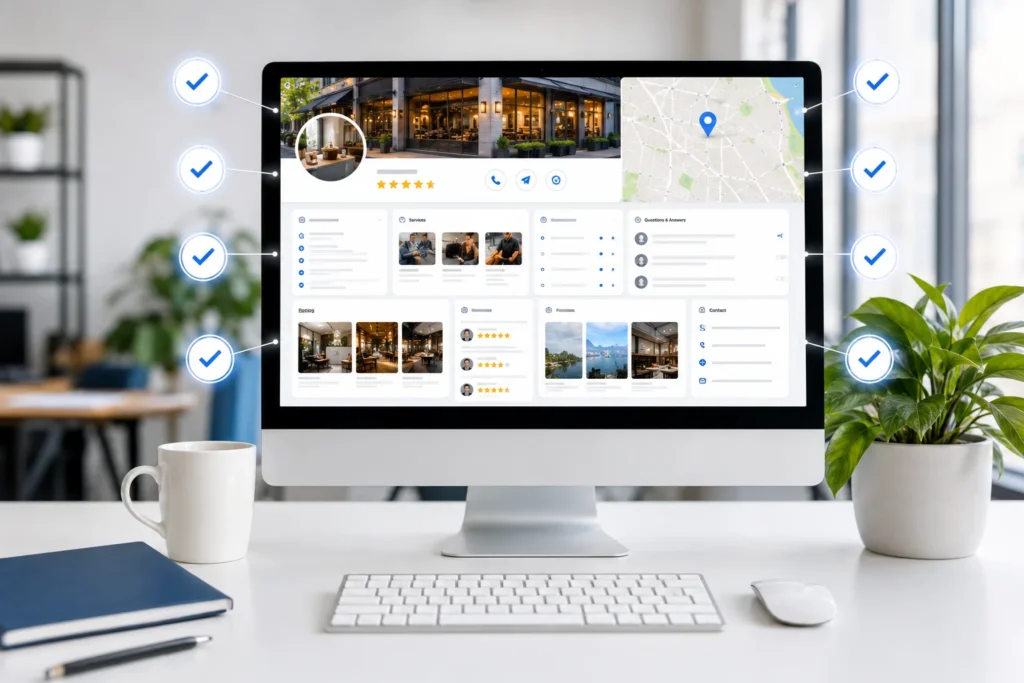
Every map pack ranking starts with a Google Business Profile. A poorly optimized GBP is the single most common reason Chicago businesses can’t break into the top 3 — even when they have strong reviews and a solid website. Based on our experience optimizing Google Business Profiles across competitive Chicago categories, the profile quality gap between a mediocre and a fully optimized GBP is significant enough to overcome a 2x review disadvantage.
Primary Category: The Most Important Decision You’ll Make
Your primary GBP category determines which searches you’re eligible to appear in. Research what categories your top-ranking competitors use — not what sounds most logical to you. In Chicago, we’ve seen category corrections produce local pack movement in under 30 days. It’s the fastest-impact change available with zero cost.
Business Description Optimization
Your GBP description (750 characters) is a relevance signal, not a mission statement. Write it to include your primary service in the first sentence, 2–3 secondary services you want to rank for, your city and 1–2 key neighborhoods, a differentiator (years in business, certifications, specialties), and a light call to action.
Photo Strategy
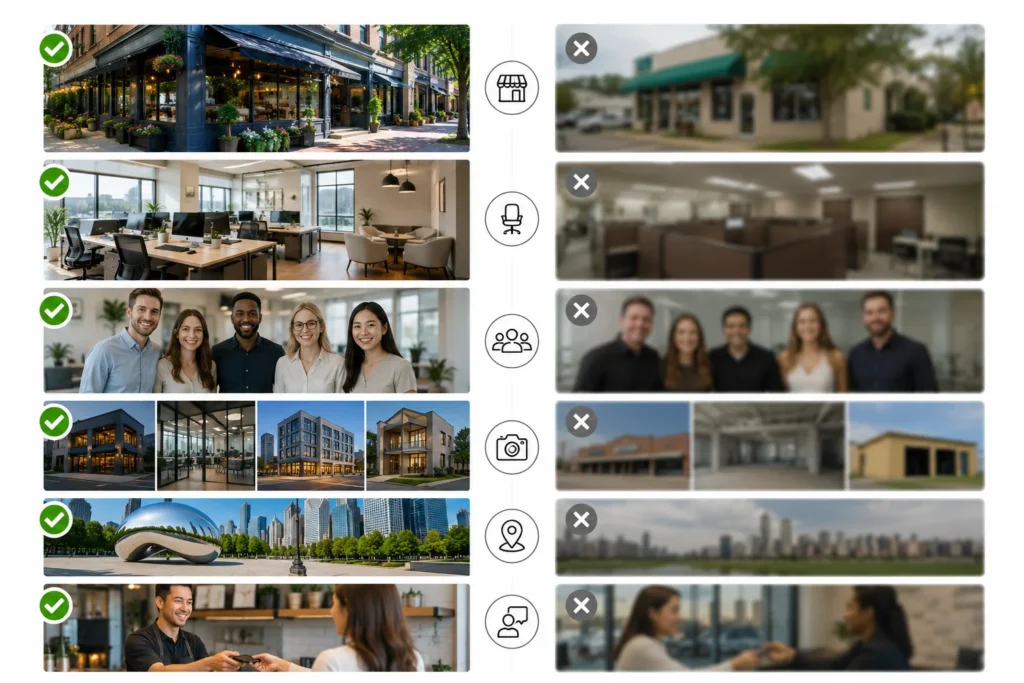
GBP profiles with regularly updated photos get significantly more clicks and calls than those with few or outdated images. Photos added within the last 90 days are weighted more heavily. A profile with a single stock photo from 2022 is losing behavioral signal ground to competitors who upload new images monthly.
Photo types that consistently perform well in Chicago client accounts:
- Exterior with street signage: Helps Google confirm your physical location. Essential for brick-and-mortar businesses.
- Team photos: Real named people build trust faster than logos.
- Work-in-progress or completed work: Before/after for trades, in-office for professional services.
- Neighborhood context: Photos that place you in the Chicago community — local landmarks, neighborhood events, street scenes.
Google Business Profile Posts: The Underused Ranking Signal
Google Posts are one of the most consistently underused tools in Chicago local SEO. Most businesses we audit have either never posted or stopped posting months ago. Consistent posting signals active profile management — a positive engagement signal — and gives you additional keyword-rich content indexed to your GBP.
Posting Frequency
Aim for 2–4 posts per month as a baseline. In high-competition Chicago categories, weekly posting is common among map pack leaders. Posts older than 7 days expire from the ‘Updates’ section of the profile, though they remain indexed. Recency matters — a profile with a post from yesterday looks more active than one with a post from last month.
Post Types That Work
- Offer posts: Time-limited promotions with a clear CTA. ‘Free estimate this month — book by Friday.’ Gets clicks from searchers already comparing options.
- Update posts: New service launch, team addition, new hours, neighborhood expansion. Keeps your profile current and relevant.
- Event posts: Sponsorships, community events, local partnerships. These carry neighborhood relevance signals that generic posts don’t.
- Product/service spotlights: Feature a specific service with a keyword-rich description. Reinforces relevance for that service category.
Post Optimization
Include your primary keyword or a secondary keyword naturally in the first sentence of each post. Add a CTA button — ‘Call now,’ ‘Book online,’ ‘Learn more’ — to every post. Link post CTAs to relevant landing pages, not just your homepage. Use locally relevant language: mention the neighborhood, reference a Chicago-specific context where it fits naturally.
UTM tip: Track every GBP post CTA link with UTM parameters so you can measure exactly how much traffic and how many conversions each post type drives. Format: ?utm_source=google&utm_medium=organic&utm_campaign=gbp-post&utm_content=[post-type]
Google Business Profile Q&A: The Section Most Businesses Ignore
The Q&A section on your GBP is indexed by Google and appears directly in your business profile. It’s one of the most consistently neglected sections we find in Chicago GBP audits — and one of the highest-opportunity ones, because the bar for competitors is equally low.
Why It Matters
Q&A content is indexed and contributes to your GBP’s topical relevance. Questions containing keywords relevant to your category add relevance signals. More importantly, unanswered Q&A sections are a trust gap — prospective customers see unanswered questions and wonder if the business is responsive.
Anyone can post a question on your GBP — including competitors. Left unmanaged, misleading questions or even negative content can sit publicly on your profile. Google does not automatically notify you of new Q&A activity.
Seeding and Managing Q&A
- Compile a list of the 8–12 most common questions your customers ask before booking or buying.
- Post each question yourself using your personal Google account (not your business account).
- Answer each question from your business account with a complete, keyword-rich response.
- Set up Google Business Profile notifications so you’re alerted when new questions are posted.
- Respond to every legitimate question within 48 hours.
- Flag and report any spam, fake, or misleading Q&A content through the profile reporting function.
⚠️ Do not post fake questions designed purely to stuff keywords. Google’s guidelines prohibit this, and it creates a pattern that looks unnatural. Seed questions that customers genuinely ask — the keyword optimization happens naturally in honest, complete answers.
UTM Tracking for Your Google Business Profile
One of the most valuable and most skipped steps in local SEO setup is adding UTM parameters to your GBP website link. Without UTM tracking, Google Analytics treats visits from your GBP the same as direct traffic or generic organic — you have no way to know how many website visitors, form fills, or phone calls originated from your Google Business Profile.
Recommended UTM Structure
GBP Website Link UTM Format:
For GBP Post CTAs:
Add this to your GBP website URL in profile settings. It takes 60 seconds and gives you attribution data most Chicago businesses don’t have.
What UTM Tracking Reveals
- Traffic volume from GBP: How many website sessions originate from your Google Business Profile vs. other sources
- Conversion rate from GBP traffic: What percentage of GBP-sourced visitors call, fill out a form, or book
- Post performance: Which GBP post types drive the most website traffic and conversions
- Seasonal patterns: When GBP traffic peaks — useful for scheduling post campaigns and promotions
Combined with GBP Insights data (calls, direction requests, profile views), UTM tracking gives you a complete picture of what your Google Business Profile is actually worth to your business in revenue terms.
Review Signals: The Prominence Factor You Control Most
Reviews remain one of the most powerful local ranking signals. But the nuance matters more than most guides acknowledge.
What Google Looks At
- Volume: More reviews improve rankings, but after a baseline (~50+ reviews), the marginal benefit of each additional review decreases and recency becomes more important.
- Recency: A review from last week outweighs one from 18 months ago. Google surfaces businesses that are currently active and trusted.
- Sentiment and keyword content: Reviews that organically mention your service type, city, and neighborhood add topical relevance to your profile. ‘Outstanding HVAC repair in Lincoln Park — fast and professional’ is a more powerful review than ‘Five stars!’
- Response rate: Responding to reviews — including negative ones — signals active profile management. Response content can include relevant keywords naturally.
- Rating consistency: A steady 4.5–4.9 rating over time signals reliability. A business oscillating between 3.5 and 4.8 suggests inconsistency.
Building a Review Generation System

Businesses that hold top map pack positions in competitive Chicago categories have systems, not occasional luck:
- Deliver the service
- Send a follow-up text or email within 24 hours with a direct GBP review link
- If no review after 5 days, send one follow-up
- Brief your team to verbally ask at the end of every positive interaction
- Respond to every review within 48 hours — positive and negative
⚠️ Never offer incentives for reviews. Never use kiosk-style review stations (Google flags IP-clustered reviews). Never buy reviews. Profile suspension from these violations is catastrophic for a local business — and in Chicago’s competitive market, losing your GBP history can set you back 12+ months.
Local Citations and NAP Consistency
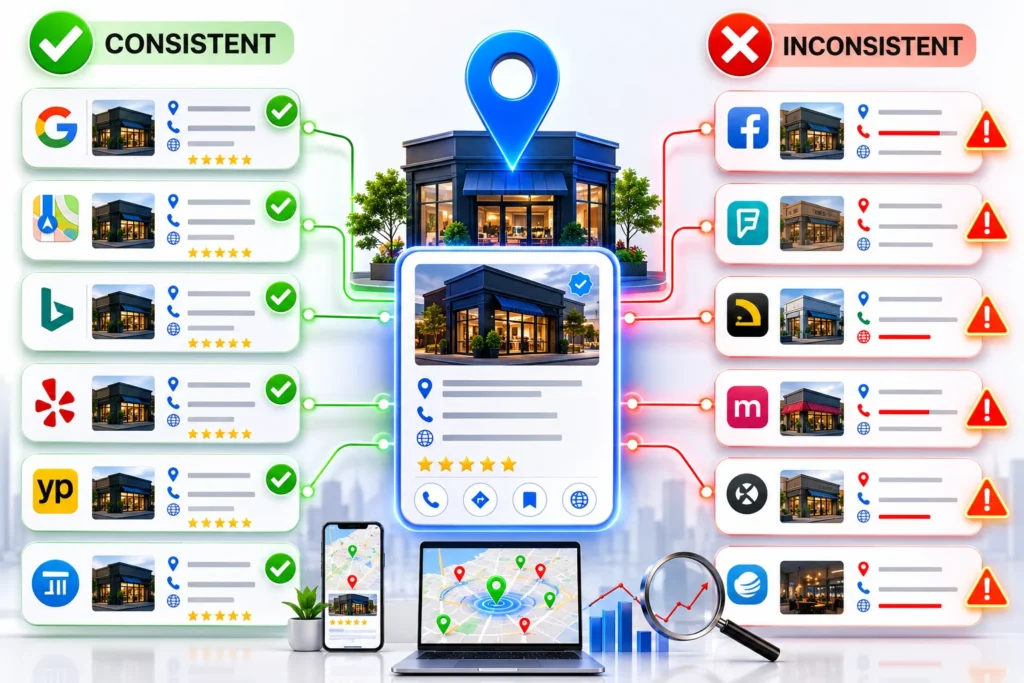
A citation is any mention of your business name, address, and phone number (NAP) online. Google cross-references citations to verify your business is real, located where you claim, and trustworthy. NAP inconsistencies — old addresses, name variations, wrong phone numbers — create trust ambiguity that suppresses local rankings.
One common issue we repeatedly find in Chicago business audits: a business has moved locations 2–3 years ago but dozens of directories still list the old address. Google sees conflicting location signals and ranks the business less confidently than competitors with clean, consistent citations.
Citation Priority for Chicago Businesses
| Tier | Platforms | Action |
| Tier 1 — Critical | Google, Apple Maps, Bing, Yelp, Facebook | Fix first — most indexed and most visible to customers |
| Tier 2 — Aggregators | Data Axle, Neustar Localeze, Foursquare | Fixes cascade to 100s of downstream directories |
| Tier 3 — Industry | Houzz, Healthgrades, Avvo, Angi (by category) | High-value niche relevance signals |
| Tier 4 — Chicago Local | Chicago Tribune directories, neighborhood BID/SSA sites, CMAP | Highest local authority signals — hardest to build, most valuable |
Entity SEO and Google’s Knowledge Graph
Google’s search engine doesn’t just crawl text — it understands entities. An entity is a real-world thing (a business, a person, a place, a concept) that Google can identify, categorize, and connect to related entities in its Knowledge Graph. For local businesses, entity optimization is the practice of making your business a clearly defined, well-connected entity in that graph.
Why Entity Authority Matters for Map Pack Rankings
When Google has high confidence in a business entity — consistent name, verified location, corroborating mentions across authoritative sources — it ranks that business more prominently and more consistently. When entity signals conflict or are thin, Google ranks with less confidence, which often means lower positions and more ranking volatility.
We’ve observed that Chicago businesses with strong entity signals — consistent GBP, clean citations, authoritative local mentions, active social profiles with matching NAP — hold their map pack positions more stably over time than those relying on a single strong signal (like reviews alone).
Building Entity Authority
- Consistent business name across all properties: Exact match — no abbreviations, no variations. ‘Zolqix Digital LLC’ and ‘Zolqix Digital’ are different entities to Google.
- Verified Google Business Profile linked to your website: The GBP-to-website connection is a fundamental entity signal.
- Social profiles with matching NAP: LinkedIn, Facebook, Instagram — all should list the same business name, address, and phone number.
- Branded search presence: Content that appears when someone searches your business name directly. Press mentions, review site profiles, social posts, your website. A business with rich branded search results has stronger entity authority than one that barely appears beyond its GBP.
- Authoritative local mentions: Crain’s Chicago Business, Block Club Chicago, neighborhood organization features. Each corroborating mention from a trusted source strengthens your entity signal.
- Knowledge Panel: If your business has a Google Knowledge Panel, claim and verify it. This is the clearest signal that Google has resolved your entity with high confidence.
GBP Spam Fighting: The Competitive Advantage Most Businesses Miss
In competitive Chicago markets, GBP spam is more common than most business owners realize. Fake or guideline-violating listings can occupy top-3 map pack positions that legitimate businesses should hold. Understanding how to identify and report spam is a legitimate competitive strategy — not a loophole.
Common GBP Spam Types in Chicago
- Keyword-stuffed business names: Listings like ‘Best Chicago Plumber 24/7 Emergency LLC’ violate Google’s guidelines. Real business names should not contain keyword phrases. This is one of the most common violations in high-competition Chicago categories.
- Fake addresses: Businesses listing addresses at virtual offices, UPS stores, co-working spaces, or addresses they don’t actually operate from.
- Duplicate listings: The same business appearing multiple times for the same location — sometimes with different names or phone numbers.
- Suspended listings reappearing: Some operators repeatedly recreate suspended profiles under slightly different names.
- Fake reviews: Clusters of reviews posted from the same IP, in the same short timeframe, often from accounts with no other review history.
How to Report GBP Spam
- Identify the violating listing in Google Maps
- Click ‘Suggest an edit’ on the listing
- Select the appropriate violation type
- For complex violations, use Google’s Business Redressal Complaint Form
- Document your report with screenshots — this strengthens the case if Google requests more information
In our experience, clear-cut violations — especially keyword-stuffed names — are actioned within 2–8 weeks with a well-documented report. Only report genuine violations. Using this as a tactic against legitimate competitors violates Google’s policies and can result in your own account being flagged.
Local Link Building for Chicago Map Pack Authority
Backlinks from locally relevant sources are one of the strongest prominence signals in Google’s local algorithm. For Chicago businesses, the quality of local links matters more than quantity — a single mention in Crain’s Chicago Business is worth more than 50 generic directory submissions.
Chicago-Specific Link Building Opportunities
- Chicago Chamber of Commerce: Member directory listings and potential feature articles. High-authority, locally trusted source.
- Neighborhood BID and SSA websites: Chicago’s 77 neighborhoods have active Business Improvement Districts and Special Service Areas, many of which publish member directories and business spotlights. These are high-value, hyper-local links.
- Local press and media: Chicago Tribune, Crain’s Chicago Business, Block Club Chicago, Chicago Reader, and neighborhood publications. PR outreach targeting local journalists covering your industry.
- Event sponsorships: Chicago neighborhood festivals, charity events, and community fundraisers. Sponsorships typically earn a link from the event website — locally relevant and contextual.
- Local business associations: Industry associations with Chicago chapters, the Chicago SBDC, SCORE Chicago, Illinois Hispanic Chamber of Commerce.
- University and hospital affiliates: If your business serves or partners with Chicago-area universities or healthcare systems, affiliate or supplier directory listings carry significant authority.
- Competitor backlink gap analysis: Use Ahrefs or Moz to identify sites linking to your top local competitors but not to you. This gap list is your most targeted link acquisition roadmap.
Local Content Clusters and Topical Authority
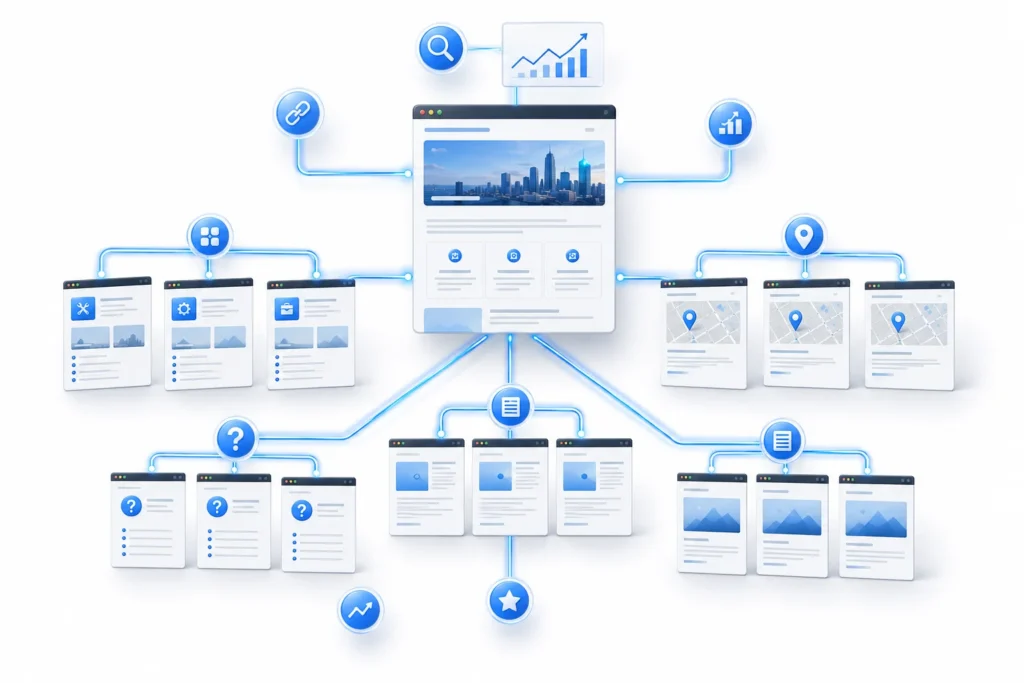
A single optimized service page is not enough to build topical authority in a competitive Chicago market. The businesses that dominate local organic results — and whose GBP prominence benefits from strong website authority — build content clusters: interconnected groups of pages that together signal deep expertise on a topic and geography.
What a Local Content Cluster Looks Like
For a Chicago HVAC company:
- Pillar page: ‘HVAC Services Chicago’ — comprehensive overview of all services
- Supporting article 1: ‘How Much Does AC Replacement Cost in Chicago?’ — informational, FAQ-rich
- Supporting article 2: ‘Furnace Repair vs Replacement: A Chicago Homeowner’s Guide’ — commercial research
- Supporting article 3: ‘Best Time to Replace Your AC in Chicago’ — seasonal, informational
- Neighborhood pages: ‘HVAC Services in Lincoln Park,’ ‘HVAC Services in Wicker Park,’ ‘HVAC Services in Andersonville’
- FAQ page: Targeting People Also Ask results for HVAC queries in Chicago
Each page links to related cluster pages. This internal linking concentrates topical authority and signals to Google that this site is a comprehensive local resource — not just a single page with keywords.
Internal Linking Strategy
Every neighborhood page should link to the main service pillar page. Every supporting article should link to both the pillar page and the most relevant neighborhood pages. The pillar page should link to all cluster content. This architecture distributes authority throughout the cluster and helps Google understand the content relationships.
Mobile-First Local Search and Voice Search in Chicago
Mobile-First Local Search Behavior
More than 60% of local searches in Chicago happen on mobile devices — and mobile searchers behave fundamentally differently from desktop users. They’re often physically in the city, searching with immediate intent, and have minimal tolerance for slow-loading or difficult-to-navigate experiences.
Mobile-first local SEO requirements:
- Page speed under 2.5 seconds on mobile: Test with Google PageSpeed Insights. Slow pages lose visitors before they see your value proposition.
- Click-to-call visible above the fold: Mobile searchers who click from the map pack expect to call immediately. If your phone number requires scrolling to find, you’re losing calls.
- Core Web Vitals compliance: Largest Contentful Paint (LCP), Interaction to Next Paint (INP), and Cumulative Layout Shift (CLS) are Google ranking signals. Poor scores hurt both local organic and GBP prominence.
- Google Maps embed on contact page: Not just a static address — an interactive map that opens in the Maps app with one tap.
- No intrusive interstitials: Pop-ups that block content immediately on mobile page load are a negative page experience signal and frustrate users arriving from local search.
Voice Search Optimization
Voice search queries are conversational and question-based: ‘Hey Google, who’s the best HVAC company near me?’ or ‘Find an emergency dentist open now in Chicago’s River North.’ To capture these:
- FAQ content: Voice search almost always pulls answers from FAQ-style content with direct, conversational responses. Structure your FAQs in natural question format.
- ‘Near me’ optimization: Include ‘near me’ language in your GBP description and website content where it fits naturally — Google connects these queries to proximity-verified businesses.
- Conversational keyword variants: Supplement head terms with long-tail, question-based phrases: ‘who fixes furnaces in Logan Square,’ ‘what time does [business] open on Sundays in Chicago.’
- Accurate hours in GBP: Voice search surfaces ‘open now’ results heavily. Inaccurate hours cause Google to suppress your listing for time-sensitive queries.
AI Overviews and Their Impact on Google Map Pack Searches
Google’s AI Overviews — the AI-generated summaries that appear at the top of some search results — rolled out broadly in 2025 and changed how information surfaces for certain query types. For local businesses focused on the Chicago map pack, the impact is more nuanced than most coverage suggests.
Where AI Overviews Impact Local Search (and Where They Don’t)
For high-intent local queries — ‘plumber near me,’ ‘best Italian restaurant in Lincoln Park,’ ’emergency HVAC Chicago’ — AI Overviews have had minimal impact. These queries still resolve to traditional map packs because Google recognizes they require current, location-specific data that AI summaries can’t reliably provide.
Where AI Overviews matter more for local businesses: the informational queries that precede a local search. ‘How much does a roof replacement cost in Chicago?’ or ‘What should I look for in a Chicago home care agency?’ are research queries that now often generate AI summaries — and if your content isn’t cited in that summary, you lose a touch point in the customer’s research journey.
How to Get Your Business Cited in AI Overviews
- Structured, direct answers: AI Overviews pull from content that directly answers the question. Write clear, specific answers — not hedged, vague paragraphs.
- FAQ optimization: FAQ sections with natural question-and-answer format are frequently pulled into AI summaries. Use FAQPage schema to make these sections machine-readable.
- Local specificity: Content with Chicago-specific context — neighborhood references, local cost ranges, Chicago regulations — is favored for locally relevant AI Overviews.
- EEAT signals: Content attributed to named experts with verifiable credentials gets prioritized. Author bios, professional credentials, and external citations strengthen AI Overview eligibility.
- Schema markup: LocalBusiness, FAQPage, and HowTo schema improve crawlability and structured data extraction for AI summaries.
Strategic implication: The best defense against AI Overview traffic displacement is becoming the source Google pulls from. Build content that directly answers the pre-search questions your customers ask — and structure it so Google can extract and attribute the answer to you.
Breaking Into the Chicago Map Pack: What It Actually Takes
Getting into the top 3 in Chicago requires sustained, simultaneous work across multiple signals. There’s no single lever. Based on our experience managing Chicago local SEO campaigns, here’s what the businesses consistently holding those top spots have in common:
1. A Fully Optimized Google Business Profile
Every field complete. Correct primary category. A business description that includes the primary service, key Chicago neighborhoods, and a differentiator. Photos updated within the last 60–90 days. Posts going out at least twice per month. Q&A seeded and managed. UTM tracking on the website link.
2. A Consistent Review Generation System
Not occasional reviews — a repeatable system. Direct GBP review link sent within 24 hours of service. One follow-up if no response in 5 days. Verbal team prompts at point of service. Every review responded to within 48 hours.
3. Clean, Consistent Citations Across All Tiers
Exact NAP match across Tier 1–4 platforms. No old addresses, no name variations, no duplicate listings. Aggregators (Data Axle, Neustar Localeze) corrected first so fixes cascade downstream.
4. A Website That Reinforces GBP Signals
NAP in footer matching GBP exactly. Dedicated page for each core service. LocalBusiness schema correctly implemented. Mobile load time under 2.5 seconds. Location pages for key Chicago neighborhoods served.
5. Local Link Authority
At least a handful of locally relevant Chicago backlinks: Chamber of Commerce, neighborhood organizations, local press. Even 5–10 high-quality local links outweigh 100 generic directory submissions.
6. Behavioral Signal Optimization
Strong GBP photos to drive click-through. Rich, keyword-containing reviews that serve as compelling listing snippets. A website that keeps visitors engaged after they click through. The behavioral layer is the product of getting everything else right.
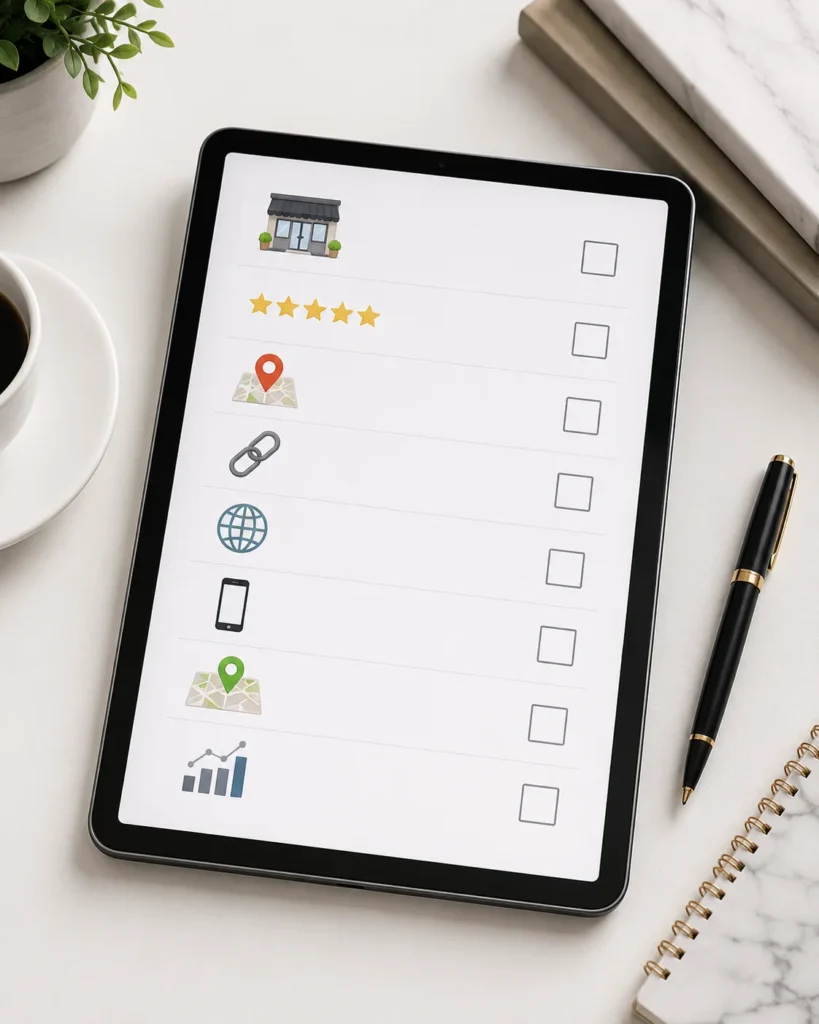
[ VISUAL: Google Maps optimization checklist — printable checklist format covering GBP, citations, reviews, website, content, links ]
Chicago Neighborhood Strategy: Go Smaller to Win Bigger
One of the most underused approaches for Chicago businesses is hyper-local targeting — deliberately competing for neighborhood-level searches before city-wide ones.
‘HVAC Chicago’ is brutally competitive. ‘HVAC Pilsen’ is not. The search intent is identical — someone in Pilsen needs HVAC. The competition is a fraction.
A practical neighborhood targeting approach:
- Identify the 3–5 Chicago neighborhoods that make up the majority of your actual customer base
- Build dedicated location pages for each — not template pages with swapped city names, but pages with original content and local references
- Earn reviews that mention those neighborhoods by name
- Get listed in neighborhood-specific resources: BID sites, SSA directories, local blog features
- Build 1–2 local links from within each neighborhood
Neighborhood-level authority compounds into broader Chicago visibility over time. The businesses ranking well city-wide usually built their local authority neighborhood by neighborhood first.
Realistic Timeline: When Does the Chicago Map Pack Start Working?
| Starting Situation | Expected Timeline | Key Bottleneck | Fastest Win |
| New business, no GBP history | 4–6 months | Review and citation foundation | Complete GBP fully in week 1 |
| Existing GBP, needs optimization | 6–10 weeks for first movement | Category and profile corrections | Fix primary category immediately |
| Established business, thin website | 3–6 months | Website content and schema | Add LocalBusiness schema this week |
| High-competition Chicago category | 6–12 months for sustained top-3 | Review velocity + link authority | Launch review system immediately |
| SAB entering new neighborhood | 2–4 months with dedicated content | Neighborhood content + local reviews | Build neighborhood page + ask for neighborhood-specific reviews |
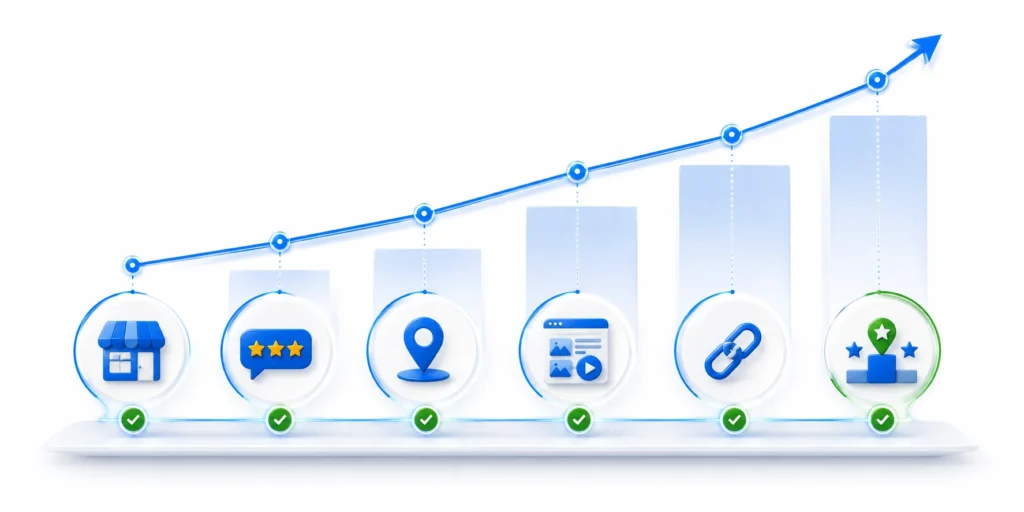
[ VISUAL: Local ranking timeline chart — month-by-month visualization showing GBP optimization, review growth, and local pack movement over 12 months ]
Local SEO compounds over time. The businesses that can’t be displaced in Chicago’s map pack have been building consistently for 18–24 months. The ones that struggle are those who start, see partial progress at month 3, pause, and restart 6 months later — losing the compounding they built.
Frequently Asked Questions About the Google Map Pack in Chicago
What is the Google Map Pack?
The Google Map Pack is the block of three local business listings — with a map — that appears at the top of Google Search results for location-based queries. Also called the local pack or 3-pack, it captures the highest click-through rate on local search results pages and is the primary target of local SEO efforts.
How many businesses appear in the Google Map Pack?
Three, by default. Google occasionally shows a ‘View all’ expansion revealing more results, and some queries return a two-pack or one-pack in special formats. The standard display for most local queries is three businesses.
Can I pay to appear in the Google Map Pack?
No. The organic map pack cannot be purchased. Google Local Services Ads (LSA) appear above the map pack for certain service categories and charge per lead — but that’s a separate paid product, not the organic map pack. The map pack is earned through local SEO.
Does my business need a physical Chicago address to rank in the Chicago Map Pack?
Yes, for most business types. Google requires a verified physical address in or near the target area to rank in the local pack. Service-area businesses can hide their address while still ranking, but a verified Chicago-area location is still required. Businesses with no physical presence in or near Chicago will not rank in the Chicago map pack.
Why does the map pack show different businesses at different times?
The map pack is dynamic. It changes based on the searcher’s physical location, the exact phrasing of the query, the time of day (open now filters), device type, and Google’s real-time algorithm assessment. A business might rank in the top 3 for a searcher in River North and not appear at all for the same query run from Bridgeport.
Why did I disappear from the Google Map Pack?
The most common causes: a competitor improved their signals (reviews, citations, content) faster than you did; your GBP was suspended or penalized; your business information was edited (by anyone — Google allows public edits) and introduced inconsistencies; Google’s algorithm updated; or a spam listing entered your category and displaced you. Run a full GBP audit when you notice a ranking drop.
How often does Google update Map Pack rankings?
Continuously. There is no fixed update schedule — Google’s local algorithm recalculates positions in near real-time based on changing signals. Major Google algorithm updates (which happen several times per year) can cause significant map pack reshuffling. Day-to-day fluctuations are normal and expected.
Does posting on Google Business Profile help rankings?
Yes, indirectly. Regular posting signals active profile management, which is a positive behavioral signal. Posts also add indexed keyword-rich content to your GBP, contributing to relevance. Businesses that post consistently tend to maintain stronger engagement signals — which feed back into rankings.
How many reviews do I need to rank in the Chicago Map Pack?
There is no fixed number. In most competitive Chicago categories, fewer than 50 reviews makes a profile thin relative to map pack leaders. In high-competition categories like legal, medical, and home services in central Chicago, top-3 positions are often held by businesses with 200–500+ reviews. The more meaningful target is: more reviews than your direct competitors, with better recency.
Can I rank in the Map Pack without a website?
Technically yes — a GBP listing alone can rank in the map pack. However, businesses with websites consistently outperform those without, because a website adds relevance signals (content, schema, NAP confirmation) and prominence signals (domain authority, indexed pages) that GBP alone cannot provide. In competitive Chicago markets, no website is a significant competitive disadvantage.
How do service-area businesses rank in the Chicago Map Pack?
Service-area businesses (SABs) can hide their physical address and define service area zones in their GBP. Google still ranks SABs based on proximity (using their registered location, not the hidden address), relevance, and prominence. SABs competing in Chicago should define their service areas precisely at the neighborhood level, build neighborhood-specific content on their website, and actively seek reviews mentioning the neighborhoods they serve.
What hurts Map Pack rankings?
Common negative signals: NAP inconsistencies across directories, duplicate GBP listings, a suspended or penalized GBP, a significant drop in review recency (no new reviews for months), a website with slow mobile load times or poor Core Web Vitals, schema markup errors, or a sudden loss of local backlinks. Competitive displacement — where a competitor significantly improves their signals — can also cause ranking drops without any change on your part.
What is proximity bias and how does it affect Chicago businesses?
Proximity bias refers to Google’s tendency to rank businesses closer to the searcher more prominently. In Chicago, this means a business in Logan Square will rank better for searches happening in Logan Square than for the same searches happening in Hyde Park. Proximity bias is most pronounced in lower-competition categories; in highly competitive categories, prominence and relevance signals can overcome a proximity disadvantage.
How do citations affect Map Pack rankings?
Citations contribute to a business’s prominence score and help Google verify the business’s existence and location. Clean, consistent citations — especially from authoritative local sources — strengthen the confidence with which Google ranks a listing. Inconsistent citations create trust ambiguity. In 2026, citation volume alone is less decisive than it was 5+ years ago; accuracy and local source quality matter more than raw count.
Can duplicate listings hurt Map Pack rankings?
Yes. Duplicate GBP listings split signals — reviews, authority, behavioral data — across two listings instead of concentrating them in one. Google may merge duplicates automatically, sometimes incorrectly. If you have a duplicate listing, merge or delete it through the GBP dashboard or by contacting Google Business Profile support.
What is the fastest way to improve my Chicago Map Pack ranking?
If you’ve never fully optimized your GBP: correct your primary category and complete every profile field first. This is the fastest-impact change and often produces movement within 4–8 weeks. After that, launch a review request system immediately — review recency is the next highest-impact signal with a relatively short feedback loop. Citations and website work follow, with longer timelines.
How do I track my Google Map Pack ranking position accurately?
Standard Google searches are personalized based on your location, account history, and device — they’re not reliable for rank tracking. Use a dedicated local rank tracker: BrightLocal, GeoRanker, or Local Falcon all simulate searches from specific addresses or zip codes and return position data that reflects what actual local searchers see.
Does social media activity affect Google Map Pack rankings?
Not directly — social signals are not a confirmed ranking factor. However, active social profiles contribute to entity authority (Google recognizing your business as real and active) and can generate local press mentions and backlinks that do influence prominence. The indirect effect is real; the direct effect is minimal.
What is a Google Knowledge Panel and how does it relate to my GBP?
A Knowledge Panel is a rich information card that appears in Google Search when someone searches for your business name directly. It pulls from your GBP, your website, and other authoritative sources. A business with a Knowledge Panel has strong entity authority — Google has high confidence in who this business is and where it’s located. Strong entity signals correlate with better map pack stability and prominence.
How does Google Business Profile spam affect my map pack position?
In competitive Chicago categories, spam listings — keyword-stuffed names, fake addresses, duplicate profiles — can occupy map pack positions that legitimate businesses should hold. Reporting genuine violations through Google’s Business Redressal Complaint Form is a legitimate competitive strategy. Clear violations are typically actioned within 2–8 weeks of a well-documented report.
What is the difference between the map pack and local organic results?
The map pack shows three GBP-driven listings with a map, appearing above organic results. Local organic results are traditional website listings that appear below the map pack and are driven primarily by website SEO signals (content, backlinks, technical SEO). Both surfaces are important for local visibility. A well-rounded Chicago local SEO strategy targets both — map pack via GBP and prominence signals, local organic via website content and authority.
Ready to Break Into the Chicago Map Pack?
The businesses holding the top 3 spots in your category right now didn’t get there by accident. They built their local SEO infrastructure correctly — GBP, reviews, citations, content, links — and maintained it consistently. The gap between where you are and where you want to be is almost always traceable to specific, fixable signals.
Zolqix Digital specializes in Google Map Pack optimization for Chicago small businesses. We audit every signal, identify exactly what’s holding your listing back, and execute a strategy built for your specific category and neighborhood — not a generic checklist.
Get Your Free Google Map Pack Audit
We’ll analyze your GBP, citation health, review signals, local pack position, and competitor gaps — and show you exactly where you’re losing ground. Delivered within 48 hours. No obligation.
→ Request Your Free Audit at zolqix.com
Schedule a Free Local SEO Consultation
Talk directly with a Chicago local SEO specialist about your category, your competitors, and a realistic 90-day roadmap for your business.
→ Book a Free 30-Minute Call at zolqix.com
Questions? Contact us at hello@zolqix.com or visit zolqix.com
Every engagement starts with an audit. We don’t recommend a package until we understand your market, your competition, and your realistic upside.
About Zolqix Digital
Looking for expert Local SEO services in Chicago? Follow Zolqix Digital on Google Business Profile for local SEO tips, customer reviews, business updates, and the latest insights on improving your Google Map Pack rankings.
Written by
zolqix — Zolqix
Digital marketing team running local SEO, Google Ads, and growth campaigns for Chicago-area businesses. We write from what we see in active accounts.
Free — $500 value
Ready to rank
in Chicago?
Get a written audit showing exactly what’s holding back your local rankings. No call. No pitch.
No credit card • Written report within 24 hours • No obligation