
How to Rank in Multiple Chicago Neighborhoods Without Spamming Google
zolqix
Zolqix Team

Every Chicago business that serves more than one neighborhood eventually faces the same problem: how do you rank for searches in Lincoln Park, Logan Square, and Pilsen without building three nearly identical pages that Google’s Helpful Content System will eventually flag?
The instinct that creates this problem is understandable. If “plumber Lincoln Park” and “plumber Logan Square” are both valuable search terms, the obvious move looks like building a page for each and swapping the neighborhood name. That pattern is called a doorway page, and it sits on Google’s published list of spam policy violations. Google’s own guidance defines doorway pages as pages “created to rank highly for specific search queries” that funnel users toward a near-identical experience — and sites identified under the Helpful Content System update criteria have, in Google’s documented case studies, seen organic visibility drop by more than 50% within weeks of a related core update.
This guide explains exactly what doorway pages are, why they trip Google’s spam detection, and the legitimate multi-neighborhood SEO framework that lets a Chicago business build genuine local relevance across several areas — the kind of relevance that survives core updates instead of being erased by them.
The core principle:
Google does not penalize a business for serving multiple Chicago neighborhoods.Learn how a complete Local SEO strategy for Chicago businesses builds long-term rankings. Google penalizes pages that exist only to capture search traffic without providing unique value — pages that are functionally identical except for a swapped neighborhood name.
The fix isn’t avoiding neighborhood-specific pages. It’s making each page genuinely different, genuinely useful, and genuinely about that specific neighborhood — the standard Google calls ‘people-first content’ under its Helpful Content System.
What Doorway Pages Are — And Why They Trigger Google’s Spam Systems
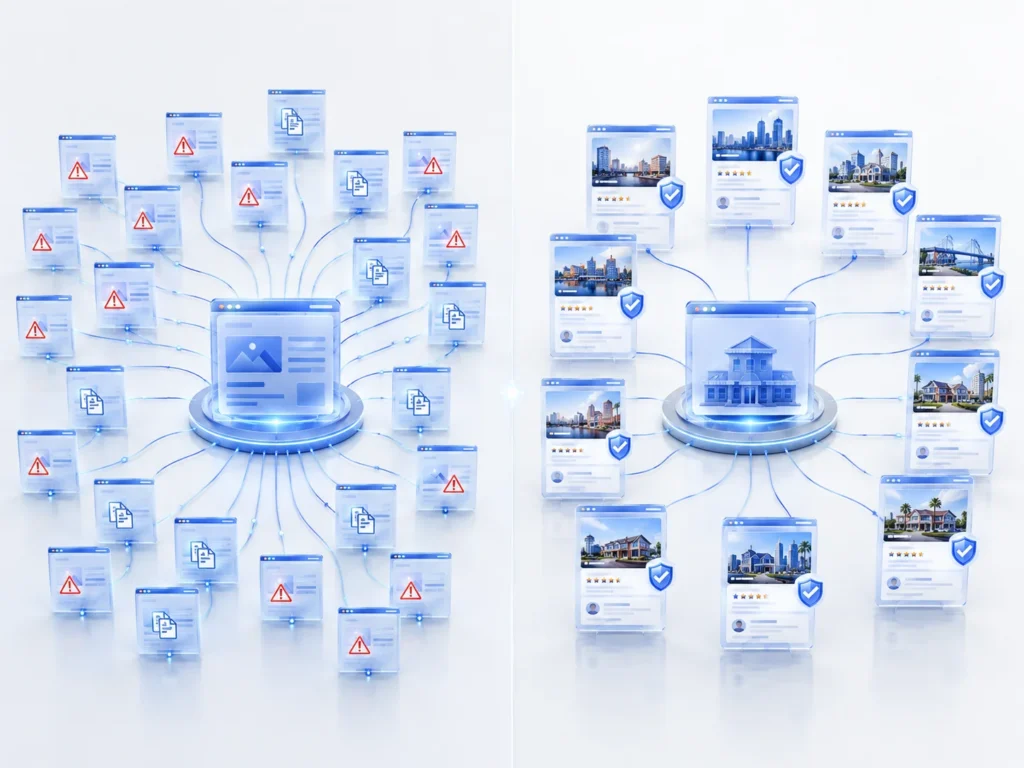
A doorway page is a page built primarily to rank for a specific search query — typically a location-modified keyword — rather than to serve a distinct purpose for the person reading it. Doorway pages appear explicitly in Google’s spam policies, and Google has run multiple targeted updates aimed at detecting and demoting them, most recently folding doorway-page detection into the broader Helpful Content System that now operates as part of Google’s core ranking systems rather than a separate filter.
The Anatomy of a Doorway Page
Doorway pages share a recognizable structure. Once you’ve seen the pattern, it’s easy to spot in your own site — or a competitor’s:
- Templated content with swapped variables: the same paragraph structure repeated across pages with only the neighborhood name changed. “Looking for a reliable plumber in [Lincoln Park / Logan Square / Pilsen]? Our team provides expert plumbing services to [Lincoln Park / Logan Square / Pilsen] residents…”
- No genuine local content: no specific references to the neighborhood beyond its name — no streets, landmarks, community context, or neighborhood-specific service considerations
- A single conversion funnel: every page leads to the same phone number, the same contact form, and the same generic call to action, with no actual differentiation in how the business serves that specific area
- Pages built for crawlers, not visitors: no user would discover these pages through normal site navigation — they exist to be indexed and found via search, then immediately redirect attention to a single generic destination
- Volume over depth: dozens or hundreds of near-identical pages targeting every conceivable neighborhood, suburb, or ZIP code combination
Why Google’s Algorithm Specifically Targets This Pattern

Google’s Helpful Content System exists to keep low-value, search-engine-first content out of results that should serve people first. Doorway pages fail that test by definition: a person searching “plumber Logan Square” and a person searching “plumber Lincoln Park” don’t need fundamentally different plumbing information — they need confirmation that you serve their area, plus something genuinely useful and specific to that fact.
Google’s published documentation on the Helpful Content System describes site-wide classifiers that evaluate overall content quality across a domain, not page by page. That distinction matters: it means a domain carrying a large volume of thin, templated location pages can see ranking suppression extend to pages that had nothing to do with the doorway pattern, including the homepage and core service pages. The mechanism is Google’s classifier treating the presence of unhelpful content as a signal about the site as a whole.
The domain-wide risk: One of the most damaging aspects of a doorway page penalty is that it is rarely confined to the offending pages. Google’s own Helpful Content System documentation states that the system evaluates overall site quality, and a domain showing a pattern of unhelpful, search-engine-first content can see ranking suppression apply across the site — including pages with strong, original content that had nothing to do with the doorway strategy.
Source: Google Search Central — Doorway Pages spam policy: developers.google.com/search/docs/essentials/spam-policies
Source: Google Search Central — Helpful Content System documentation: developers.google.com/search/docs/fundamentals/creating-helpful-content
Doorway Pages vs. Legitimate Location Pages
| Dimension | Doorway Page | Legitimate Location Page |
| Content origin | Templated structure with variables swapped | Written independently for the specific area |
| Local specificity | Neighborhood name only | Streets, landmarks, building types, local context |
| Proof points | Generic or reused testimonials | Reviews and project examples from that area |
| FAQ content | Identical across pages, if present at all | Questions genuinely specific to that area |
| Metadata | Title/meta description templated | Unique title tag, meta description, H1 |
| Internal links | Isolated, minimal organic linking | Linked from hub pages and relevant blog content |
| Publishing pattern | Large batch, same date | Built incrementally, prioritized by data |
| Google’s likely response | Helpful Content System suppression, site-wide risk | Indexed and ranked as genuine content |
Do You Actually Need Pages for Multiple Chicago Neighborhoods?

Before building any multi-neighborhood content strategy, answer this honestly: does your business have a genuine reason to create distinct content for each Chicago neighborhood you serve, or is the goal to manufacture search visibility?
Legitimate Reasons for Neighborhood-Specific Pages
- You have something different to say: different service availability, response times, pricing structures, or neighborhood-specific considerations — older housing stock in Logan Square requiring a different plumbing approach than newer construction in the South Loop, for example
- You have real local presence or proof: completed projects, customer testimonials, or community involvement specific to that neighborhood that you can document and show
- The neighborhoods present genuinely different customer needs: a moving company serving high-rise buildings in River North and single-family homes in Beverly faces different logistical realities worth explaining separately
- Search volume justifies dedicated content: if “HVAC repair Lincoln Park” carries meaningful, verifiable search volume on its own, a dedicated page is a reasonable content investment — not every neighborhood combination clears that bar
When a Single Page Is the Right Answer
- Low search volume for the specific combination: if a keyword tool shows negligible volume for “pet grooming West Town,” a dedicated page is wasted effort regardless of how well it’s written
- Genuinely identical service delivery: if your service is delivered the same way regardless of location — a remote bookkeeping service, for instance — forcing artificial differentiation into location pages produces exactly the thin content the Helpful Content System is built to catch
- A small number of adjacent neighborhoods served: a business covering 2–3 adjacent areas is often better served by one strong service page that mentions all of them naturally, paired with accurate Google Business Profile service area settings, than by splitting thin content across multiple pages
A practical test: Try writing 500+ words of genuinely useful, neighborhood-specific content for the page without padding or repetition. If the words come from real local knowledge, build the page. If you’re struggling to find anything to say beyond the neighborhood name, that’s the signal you don’t need a dedicated page yet — strengthen your core service page and let Google Business Profile service area settings do the work instead.
The Legitimate Multi-Neighborhood Framework

This is the complete framework for ranking across multiple Chicago neighborhoods without triggering spam detection — built around genuine differentiation and entity consistency rather than keyword substitution.
Layer 1: Google Business Profile Service Area Settings
Before building any pages, your Google Business Profile (GBP) service area settings should accurately reflect every neighborhood you genuinely serve. This is the foundational, lowest-risk way to signal multi-neighborhood coverage — it requires no content creation and carries no spam risk, because it’s a defined Google product feature, not a workaround.
- Set your service area to include every Chicago neighborhood you genuinely serve: GBP supports up to 20 service areas — use them accurately, since service area is itself a relevance signal in the Local Pack algorithm
- Don’t list neighborhoods you don’t actually serve: inflating your service area beyond genuine coverage weakens relevance signals and risks triggering Google’s spam detection for GBP service area abuse, a separate policy area from doorway pages
- For multi-location businesses: create a separate, fully verified GBP for each physical location — this is explicitly supported by Google and is the correct approach for businesses with genuine multiple offices, not a workaround for single-location businesses
Layer 2: One Strong Hub Page Per Service
Your primary service pages should be comprehensive, well-optimized, and explicitly mention the full range of Chicago neighborhoods you serve, without needing a dedicated page for each one. This hub page captures broad “Chicago” searches and anchors the site architecture that neighborhood-specific pages link back to — a structure that also builds topical authority for the service category as a whole.
- Comprehensive service description: everything a customer needs to know about the service, written once and done well
- Natural neighborhood mentions: “We provide HVAC services throughout Chicago, including Lincoln Park, Logan Square, Wicker Park, Pilsen, and the South Loop” — natural, not keyword-stuffed
- Links to dedicated neighborhood pages: where you’ve built them (Layer 3) — creating an internal linking structure that distributes authority and signals a coherent site hierarchy to Google’s crawlers
Layer 3: Selective, Genuinely Differentiated Neighborhood Pages

This is where execution most often goes wrong. Build dedicated neighborhood pages only for the areas that justify the investment, and make each one substantively different rather than templated.
What makes a neighborhood page genuinely different (not a doorway page):
- Real local context: specific streets, landmarks, building types common to that neighborhood — vintage greystones in Logan Square versus high-rises in River North — and how your service specifically applies to them
- Neighborhood-specific customer scenarios: “In Pilsen’s older housing stock, the most common service request involves [specific issue]” versus “In the South Loop’s newer high-rises, the most common request is [a different specific issue]”
- Genuine proof points: completed projects, customer testimonials, or reviews specifically tied to that neighborhood — not a generic testimonial reused across pages
- Neighborhood-specific FAQ content: questions that are genuinely different by area — parking and access in dense neighborhoods, HOA or condo board considerations in high-rise-heavy areas, permitting in historic landmark districts
- Unique metadata: distinct title tags, meta descriptions, and H1s, not templated substitutions with a single variable changed
- Original photography where feasible: photos of completed work in that neighborhood rather than stock images reused across every location page
Genuine differentiation checklist — confirm before publishing any neighborhood page:
At least 60% of the body content is unique to this page, not duplicated from other neighborhood pages with names swapped
The page references at least 2–3 specific, verifiable local details (streets, landmarks, building types, community characteristics)
The page includes at least one genuinely neighborhood-specific FAQ or consideration
Title tag, meta description, and H1 are written specifically for this page, not templated
The page would still be useful and informative if the neighborhood name were removed from the title — meaning it has substance beyond the location label
Layer 4: Content Clusters Around High-Value Neighborhoods

For your highest-priority Chicago neighborhoods — the ones with the most search volume or competitive opportunity — extend beyond a single location page. Build a small content cluster: the neighborhood location page itself, plus one or two supporting blog posts genuinely relevant to that area. This is the same content cluster logic Google rewards for topical authority more broadly, applied at the neighborhood level.
Example for a home services business prioritizing Lincoln Park: the Lincoln Park location page (Layer 3), paired with a blog post such as “Plumbing Considerations for Lincoln Park’s Vintage Greystones” or “What Lincoln Park Homeowners Should Know About Sewer Line Inspections in Older Chicago Housing Stock.” Content like this is useful independent of its location targeting, reinforces neighborhood relevance organically, and bears no resemblance to a doorway page because it has informational substance that exists on its own merits.
How Many Neighborhood Pages Should You Actually Build?
This is a sequencing and prioritization decision, not a build-as-many-as-possible decision. Use the table below to match your situation to a recommended approach.
| Business Situation | Recommended Approach | Pages to Build | Why |
| Single location, 2–3 adjacent neighborhoods | One hub page mentioning all areas + GBP service area | 0–1 dedicated pages | Volume likely doesn’t justify split content |
| Single location, 5–8 neighborhoods | Hub page + dedicated pages for top 2–3 by volume | 2–3 dedicated pages | Concentrate content investment on highest-ROI areas first |
| Single location, 10+ neighborhoods citywide | Hub page + top 4–6 priority neighborhoods, expand quarterly | 4–6 to start | Building all at once risks rushed, thin content |
| Multiple physical locations | Separate verified GBP per location + dedicated page per location | One page per verified location | The Google-endorsed multi-location structure |
| Service-area business, high-competition category | Hub page + 3–5 pages for highest-value neighborhoods only | 3–5 pages, prioritized by ROI | Quality over coverage in competitive categories |
A practical prioritization method: rank target Chicago neighborhoods by three factors — search volume for your service plus that neighborhood, competitive intensity, and your actual customer concentration in that area. Build dedicated pages for the top 3–5 first, measure results over a 90-day window using Google Search Console impression and click data, then expand to additional neighborhoods based on what’s already working rather than spreading thin content across too many areas simultaneously.
Side-by-Side Example: Doorway Pattern vs. Legitimate Page
Abstract guidance is useful, but seeing the contrast directly makes the standard concrete. Below is a side-by-side for a hypothetical Chicago plumbing company targeting Lincoln Park and Logan Square.
The Doorway Page Pattern (What Gets Flagged)
Lincoln Park page: “Looking for a reliable plumber in Lincoln Park? Our experienced team provides expert plumbing services to Lincoln Park residents and businesses. We offer drain cleaning, water heater repair, and emergency plumbing services throughout Lincoln Park. Contact us today for fast, reliable plumbing service in Lincoln Park!”
Logan Square page: “Looking for a reliable plumber in Logan Square? Our experienced team provides expert plumbing services to Logan Square residents and businesses. We offer drain cleaning, water heater repair, and emergency plumbing services throughout Logan Square. Contact us today for fast, reliable plumbing service in Logan Square!”
The only difference between these two pages is the neighborhood name. This is precisely the pattern Google’s Helpful Content System is designed to detect.
The Legitimate Pattern (What Ranks and Stays Ranked)
Lincoln Park page: Opens with specific context about Lincoln Park’s housing stock — predominantly vintage greystones and courtyard buildings built between 1890 and 1930, many retaining original cast iron plumbing that requires specific expertise. Covers common issues in pre-war Lincoln Park homes, including galvanized pipe corrosion and outdated venting in converted multi-unit buildings. Features a testimonial from a homeowner near Armitage and Halsted. Includes an FAQ on condo association approval processes common in Lincoln Park’s converted greystones. Links to a supporting post: “Why Lincoln Park’s Vintage Homes Need Different Plumbing Solutions.”
Logan Square page: Opens with context on Logan Square’s mix of historic boulevard mansions along Logan Boulevard and newer multi-unit development near the Blue Line corridor. Addresses the plumbing considerations of the neighborhood’s redevelopment — older infrastructure connecting to newer construction. Features a testimonial from a customer near the Logan Square Boulevards Historic District. Includes an FAQ on permit requirements for plumbing work in Logan Square’s landmark district. Links to a supporting post: “Plumbing Permit Requirements in Chicago’s Landmark Districts.”
These two pages couldn’t be templated against each other. The content, the FAQ, the testimonials, and the supporting blog links are all genuinely different because the underlying local context is genuinely different — which is the substantive distinction Google’s classifiers are built to recognize.
Technical Implementation: Internal Linking and Site Architecture

How you structure and link neighborhood pages matters nearly as much as the content itself. The right architecture signals to Google that these pages are part of a coherent, useful site — not a spam farm assembled in a single batch.
The Hub-and-Spoke Model
- Your primary service page (the hub) links to every neighborhood-specific page built for that service
- Every neighborhood page links back to the primary service hub page
- Neighborhood pages link to genuinely relevant supporting blog content, not to every other neighborhood page indiscriminately
- Main navigation features the service hub, not a sprawling dropdown of every neighborhood — neighborhood pages should be discoverable through the hub page rather than cluttering primary navigation
- A dedicated ‘Service Areas’ page can list all neighborhoods served, including ones without dedicated pages, and link to dedicated pages where they exist
URL Structure
Use clean, logical URL patterns: yoursite.com/plumbing-services/lincoln-park/ rather than flat or generic patterns that don’t reflect a coherent site hierarchy. A logical URL structure signals organized, intentional architecture rather than mass-produced location pages, and it makes the internal linking model easier for both users and crawlers to follow.
Technical Red Flags to Avoid
- Auto-generated sitemaps with dozens of location URLs added on a single date: this publishing pattern is detectable and reads as programmatic content generation rather than genuine content development
- Identical structure and load characteristics across all location pages: genuinely different content usually produces genuinely different page characteristics — pages that are structurally identical except for swapped text are a recognizable signature
- Minimal organic internal linking from high-traffic pages to new location pages: doorway pages are often isolated within the site structure because they weren’t built as part of a coherent content strategy
Reviews and GBP: The Multi-Neighborhood Signal Google Trusts Most

Beyond website content, Google Business Profile and review content provide the most powerful — and lowest-risk — way to signal genuine multi-neighborhood coverage, because these signals are inherently harder to fabricate at scale than website text.
Encourage Neighborhood-Specific Review Content
When customers from different Chicago neighborhoods leave reviews, a natural, non-scripted prompt to mention their neighborhood and the specific service received produces review content like: “Fixed our water heater fast — we’re in Logan Square near the Boulevard.” According to BrightLocal’s annual Local Consumer Review Survey, the substance of review content (not just star rating) increasingly factors into how both consumers and Google’s systems assess local business relevance. Organic neighborhood mentions across a review base create a genuine, difficult-to-fake signal of real multi-area service delivery.
GBP Posts Targeting Different Neighborhoods Over Time
Rotating GBP posts to highlight work across different neighborhoods — a recent project in Pilsen this month, a seasonal tip relevant to Lincoln Park’s older housing stock next month — reinforces multi-neighborhood relevance without requiring dozens of new pages. This is a legitimate use of the GBP Posts feature, which Google has confirmed contributes to profile engagement signals.
For Multi-Location Businesses: Separate, Fully Verified GBPs
Businesses with genuine multiple physical locations across Chicago neighborhoods should use a separate, individually verified GBP for each location, not one GBP claiming an unrealistic service area, and not doorway pages compensating for a single-location GBP. Each location’s GBP accrues its own reviews, photos, and verified address, building entity-specific authority that compounds independently over time — the structure Google explicitly documents as correct for multi-location service area businesses.
How to Audit Your Existing Site for Doorway Page Risk

If your Chicago business website already has location pages, audit them against this checklist to identify doorway page risk before an algorithm update does it for you.
Doorway Page Risk Audit:
Pull up two of your neighborhood pages side by side and read both completely. Could you swap the neighborhood names without noticing a meaningful difference in the content?
Check content similarity with a tool like Copyscape or Siteliner — are your location pages flagged as near-duplicate content against each other?
Do your location pages include any specific, verifiable local details — street names, landmarks, building types — beyond the Neighborhood name itself?
Do your location pages have unique title tags, meta descriptions, and H1s, or are they templated substitutions?
Do genuine internal links point to these pages from your main content, or were they built in isolation?
Were all your location pages published in a single batch, or have they been developed over time with real content investment?
Check Google Search Console — are your location pages actually receiving organic impressions and clicks, or are they effectively invisible in search, a possible sign Google is already suppressing them?
If the audit identifies doorway page risk: Don’t delete everything at once. Prioritize rewriting the highest-value neighborhood pages with genuine differentiation first. For lower-priority pages that don’t justify the content investment required to fix them properly, consolidate them into the main service hub page rather than leaving thin content live — a smaller number of strong pages consistently outperforms a larger number of thin ones.
Common Mistakes Chicago Businesses Make When Targeting Multiple Neighborhoods

Beyond the doorway page pattern itself, several adjacent mistakes consistently undermine multi-neighborhood SEO efforts even when the core content is reasonably solid.
Mistake 1: Treating GBP Service Area as an Afterthought
Many businesses build neighborhood pages on their website while leaving their Google Business Profile service area set to a single city or left at the default. Since GBP service area is itself a relevance signal for the Local Pack, a mismatch between your website’s neighborhood targeting and your GBP’s configured service area sends mixed entity signals to Google about where you actually operate.
Mistake 2: Publishing All Neighborhood Pages on the Same Day
A sitemap showing 15 new location pages with identical publish dates is a detectable pattern that resembles programmatic content generation, regardless of how well-written the pages are. Staggering publication over weeks or months, tied to genuine content development, produces a more natural content velocity signal.
Mistake 3: Ignoring Neighborhood-Level Search Console Data
Search Console doesn’t break out impressions by neighborhood directly, but filtering the Queries report for neighborhood-modified keywords reveals which areas are already generating impressions without a dedicated page — these are the strongest candidates for new neighborhood pages, since demand is already proven before any content is built.
Mistake 4: Skipping the Internal Link from High-Authority Pages
A new neighborhood page that’s only linked from a footer or a buried ‘service areas’ list receives a fraction of the internal authority it would get from a contextual link placed within the relevant hub service page’s body content. Internal link placement and anchor text both factor into how much topical relevance a new page inherits from the rest of the site.
Mistake 5: Reusing the Same Reviews Across Every Page
Embedding the identical set of testimonials on every neighborhood page undercuts the differentiation the page is trying to establish. Sourcing or requesting reviews that specifically reference the neighborhood in question, and featuring different reviews on different pages, reinforces rather than contradicts the genuine-local-relevance signal the rest of the page is built around.
Frequently Asked Questions
What are doorway pages and why does Google penalize them?
Doorway pages are web pages created primarily to rank for specific search queries — typically location-modified keywords — rather than to provide genuinely different value to users. They’re characterized by templated content with only minor variables, such as a neighborhood name, swapped between pages, minimal unique local context, and a structure designed for search visibility rather than user usefulness. Google’s published spam policies name doorway pages explicitly, and the Helpful Content System now evaluates this pattern as part of core ranking systems rather than a standalone filter. Because that system assesses overall site quality, penalties are often domain-wide rather than confined to the offending pages, meaning a doorway page strategy can suppress rankings across an entire website, not just the thin pages themselves.
How do I rank in multiple Chicago neighborhoods without doorway pages?
Use a layered approach. First, accurately configure your Google Business Profile service area to reflect every neighborhood you genuinely serve — this requires no content and carries no spam risk. Second, build one comprehensive service hub page that naturally mentions all the neighborhoods you serve. Third, build dedicated neighborhood pages only for your highest-priority areas, based on search volume and competition, making each one genuinely different: real local context, neighborhood-specific FAQ content, genuine testimonials from that area, and unique metadata. Fourth, for your top neighborhoods, build supporting content clusters with blog posts that are independently useful and naturally reinforce local relevance. This builds durable rankings that hold up under core updates, unlike templated doorway pages that are specifically what those updates are designed to catch.
Should I create a separate Google Business Profile for every Chicago neighborhood I serve?
Only if you have a genuine, independently verifiable physical location in each neighborhood. Creating multiple GBPs for a single physical location, even one serving multiple neighborhoods, violates Google’s guidelines and risks suspension of all associated listings. For service-area businesses operating from one location, the correct approach is a single GBP with accurately configured service area settings covering every neighborhood genuinely served, up to the 20-area limit. Only businesses with genuinely separate, independently staffed physical offices should create separate GBPs, one per verified location, which is the structure Google explicitly documents for multi-location service area businesses.
How much unique content does a Chicago neighborhood page need to avoid being flagged as a doorway page?
Google has not published an official minimum word count, but a useful practical benchmark is that at least 60% of a page’s body content should be genuinely unique to that specific page, not duplicated or lightly modified from other neighborhood pages. Substance matters more than length: the page should reference specific, verifiable local details such as streets, landmarks, or building types, include at least one neighborhood-specific consideration or FAQ, and provide real value to a reader even without identifying which neighborhood it covers. A 400-word page built on genuine local knowledge is a safer bet than a 1,000-word page that is mostly templated boilerplate with the neighborhood name swapped in.
What is the difference between a location page and a doorway page?
A location page is a legitimate page providing genuinely useful, differentiated content about how a business serves a specific geographic area — real local context, customer scenarios specific to that area, genuine proof points, and information a searcher from that neighborhood would find valuable. A doorway page is structurally similar, in that it targets a location-modified keyword, but lacks genuine differentiation: it exists primarily to capture search traffic, with content that’s templated or only superficially different from equivalent pages built for other locations. The distinction Google’s classifiers are built to detect is substantive uniqueness and genuine user value, not the mere existence of location-specific pages. Location pages built correctly are a legitimate and effective SEO strategy; doorway pages are a manipulation attempt subject to penalty.
How many Chicago neighborhood pages should a business build?
This depends on business model, service area size, and available content resources. For a single-location service business serving 5 to 10 Chicago neighborhoods, a reasonable starting approach is dedicated pages for the top 3 to 5 highest-priority areas, based on search volume and competitive opportunity, then expanding over time as results are validated and capacity exists to invest in genuinely differentiated content for additional areas. Building 15 to 20 neighborhood pages simultaneously, particularly without the content resources to make each one genuinely unique, significantly increases doorway page risk. Quality and genuine differentiation should consistently take priority over comprehensive geographic coverage.
Can a site recover from a doorway page penalty?
Yes, but recovery requires real remediation rather than quick fixes. The process: identify and either consolidate or substantially rewrite thin, templated location pages — merging low-value pages into the main service hub page, or investing in making the highest-priority pages genuinely unique with real local content. Pages that can’t be meaningfully differentiated should be removed or set to noindex. Once the underlying pattern is addressed, a reconsideration request can be filed through Google Search Console if a manual action was issued. Algorithmic suppression tied to Helpful Content System-style classifiers typically resolves once site quality genuinely improves and Google’s systems re-evaluate the domain, a process that can take weeks to months rather than days.
Does this apply to suburbs around Chicago too, or just neighborhoods within the city?
The same principles apply identically whether the target is Chicago neighborhoods such as Lincoln Park, Logan Square, or Pilsen, or surrounding suburbs such as Naperville, Schaumburg, Evanston, or Oak Park. Google’s spam detection evaluates content uniqueness and user value regardless of whether the geographic unit is technically a neighborhood or a suburb. A business serving both Chicago neighborhoods and surrounding suburbs should apply the same hub-and-spoke framework, the same genuine differentiation standard, and the same prioritization approach across its entire multi-area content strategy.
The Bottom Line: Multi-Neighborhood SEO Done Right
Ranking in multiple Chicago neighborhoods does not require choosing between visibility and compliance with Google’s guidelines. It requires choosing between two strategies: the fast, templated approach that works temporarily and carries domain-wide penalty risk, or the more deliberate approach that builds genuine, durable local authority and entity consistency.
- Start with GBP service area settings: free, low-risk, and the foundational signal for any multi-neighborhood business
- Build one strong hub page first: comprehensive, well-optimized, naturally mentioning every area served
- Add dedicated neighborhood pages selectively: only for the highest-priority areas, only with genuine differentiation
- Apply the substance test to every page: if 60%+ unique, locally specific content isn’t achievable yet, hold off on building the page
- Build content clusters around top neighborhoods: supporting blog content reinforces relevance without doorway page risk
- Let reviews and GBP carry the multi-neighborhood signal organically: the hardest-to-fake, most trusted indicator of genuine area coverage
The Chicago businesses ranking durably across multiple neighborhoods through 2026 are not the ones that built the most pages fastest. They’re the ones that treated each neighborhood as worth understanding on its own terms, and built content that reflects that understanding — the standard Google’s Helpful Content System is explicitly designed to reward.
Get a Free Multi-Neighborhood SEO Risk Audit for Your Chicago Business
Within 48 hours, you’ll receive a written report scoring every existing location page against the doorway-page risk checklist in this guide, a ranked list of your highest-opportunity Chicago neighborhoods based on real search volume and competition data, and a sequenced content plan showing exactly which pages to build first and why. No generic template — every recommendation is built from your actual site and your actual market.
Request Your Free Audit at zolqix.com
Talk Through Your Expansion Plan With a Chicago Local SEO Specialist
A 30-minute call, no slide deck — just a direct conversation about which neighborhoods are worth a dedicated page for your specific category, what a realistic content timeline looks like, and how to avoid the mistakes this guide covers.
Book Your Free 30-Minute Call at zolqix.com
Questions? Contact us at hello@zolqix.com or visit zolqix.com
About This Guide
Author: Zolqix Digital Local SEO Team — Chicago-based local SEO practitioners specializing in multi-location and multi-neighborhood service area strategy for Chicago metro businesses.
Reviewed By: Senior Local SEO Strategist, Zolqix Digital (West Loop, Chicago)
Experience Statement: This guide reflects direct work auditing and building Chicago-area location page architecture across home services, legal, healthcare, and professional services categories, applying Google’s published spam policies and Helpful Content System documentation as the technical standard throughout.
Last Reviewed: July 2026
Next Scheduled Review: December 2026 — this guide will be updated to reflect any changes to Google’s spam policies, Helpful Content System documentation, or Local Pack ranking factors.
Published by Zolqix Digital — Chicago Local SEO Agency | zolqix.com
Written by
zolqix — Zolqix
Digital marketing team running local SEO, Google Ads, and growth campaigns for Chicago-area businesses. We write from what we see in active accounts.
Free — $500 value
Ready to rank
in Chicago?
Get a written audit showing exactly what’s holding back your local rankings. No call. No pitch.
No credit card • Written report within 24 hours • No obligation